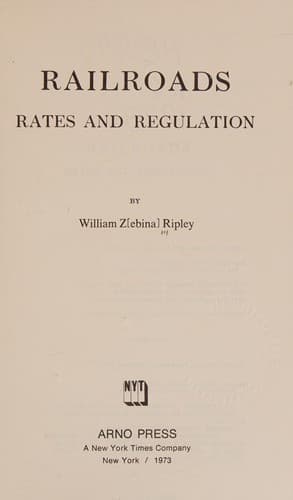
Railroads: Rates and RegulationsRipley, William Zebina
History
Railroads: Rates and Regulations
Ripley, William Zebina
Railroads -- Freight -- Rates -- United States; Railroads and state -- United States
A concrete example may aid in making this important principle clear.
The new through-freight trunk line built by the Pennsylvania Railroad
since 1900, paralleling its old four-track one, represents both in the
cost of maintenance and capital charges, a sudden jump in the expense
of transporting each ton of freight on _both_ lines, until such time
as the new business grows to a point where it can support the new line
by itself alone. The relation between increasing returns and density
of traffic is well illustrated in this instance. With six tracks in
operation nearly all the way from Pittsburg to Philadelphia, the four
old tracks are sometimes almost fully utilized for passengers and fast
freight. The extraordinary density of traffic appears in the statement
that this road in 1911 on 3534 miles of track handled one-third more
ton miles than the Union Pacific--by far the most worked of all the
western lines--handled on 13,674 miles of track. The two new low-grade
Pennsylvania freight tracks are used only for slow traffic; largely
coal and westbound steel empties. Not-withstanding the extraordinary
density of traffic on this extra two track line, it probably does
not meet the fixed charges on cost of construction of the line. Yet
the new double track was absolutely necessary, regardless of its
profitableness, in order to relieve congestion on the old four tracks.
In other words, the demands of the service forced an expenditure which
in and of itself was not financially self-supporting. But the profit
from the old lines would be sufficiently enhanced to take care of
the whole. The bearing of such cases upon the capital needs of the
future is obvious. A resolutely conservative policy of finance becomes
imperative under such circumstances.
In much the same way, the general condition of congestion reached
in 1903-'05 on the eastern trunk lines and in the West and South in
1906-'07, manifested mainly in the need for more tracks and terminals,
represented the permanent outgrowth of the old plant; and necessitated
a readjustment of capital expenses for the purpose of enlargement.
Viewed in a large way over a term of years, nearly every expenditure,
even the fixed charges which appear constant or independent of the
volume of business, thus become in reality imbued with more or less
variability.
Public-domain text, read in full here on John Shaqi.
Reviews
Reviews
No reviews yet
Be the first to share your thoughts on this work.
Join the Discussion
Join the discussion
Sign in to leave a comment or review.
Sign InorCreate an account