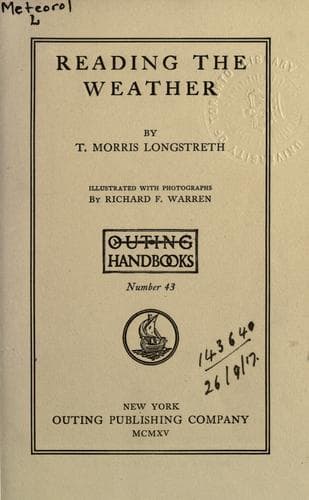
Reading the WeatherLongstreth, T. Morris (Thomas Morris)
Science
Reading the Weather
Longstreth, T. Morris (Thomas Morris)
Weather forecasting
But if the storm rises slowly against the wind, requiring an hour or two
or three to approach and break, the lightning will grow almost
continuously, some of the flashes being broad streamers cleaving the
western sky. It is this sort of lightning that does the damage. The
thunder, instead of rolling like an empty barrel, hits into a series of
concussions. If the lightning strikes an object nearby the crash is
rather appalling. There are several freak sorts of lightning such as the
ball form, which are rare.
The approach of the center of disturbance may be gauged by the length of
time that elapses between flash and crash. In reality the thunder occurs
immediately after the discharge of electricity, but sound travels so
slowly, compared to light, that a minute may intervene between stroke and
clap. You may count the seconds, noticing the regular decrease, signifying
the nearing of the crisis. Soon a flash in front and a simultaneous peal
will show you that you are in the thick of things. The next bolt or two
may hit very close and you can appreciate what it means to be on the
firing line. Then the next river of fire with its detonation streams
behind you and you are saved.
In a severe thunderstorm there are several centers, several nuclei that
shed destruction like great batteries and their progress over and beyond
you has its thrills. You may find the exact number of feet away that the
bolt hit by multiplying the number of seconds elapsing between the
lightning and thunder by 1120. But an easier way is to allow a mile for
every five seconds on the watch. One or two seconds, and you are pretty
near the center of the fray.
Lightning compresses the air, leaving a partial vacuum. The other air
rushing in to fill this partial vacuum forms the wave motion that produces
the noise. That is the whole why of thunder. The reason thunder rolls is
that the lightning is a series of discharges each of which gives rise to a
particular detonation. If lightning were but one discharge, the thunder
would be but one stupefying crash. Reflections from the clouds and from
layers of air of different densities and from the ground are agencies that
prolong the sound.
Our atmosphere is never lacking in electricity. This electricity is always
positive in clear weather and sometimes negative in cloudy. Science
concludes, then, that negative electricity invariably indicates rain,
hail, or snow within a radius of forty miles.
Moist air is a good conductor. Our powerful motors can now produce a spark
of electricity several feet long. But some of the flashes that shoot
across the sky in a big storm extend over five miles. The duration of the
flash varies from 1-300th of a second to a second. The reason that
lightning does not always pass imperially along a straight line is that
some air, either moister or warmer than the air around it, offers less
resistance. The lightning takes this line of least resistance along the
pathway of warmer or less dense air.
Public-domain text, read in full here on John Shaqi.
Reviews
Reviews
No reviews yet
Be the first to share your thoughts on this work.
Join the Discussion
Join the discussion
Sign in to leave a comment or review.
Sign InorCreate an account