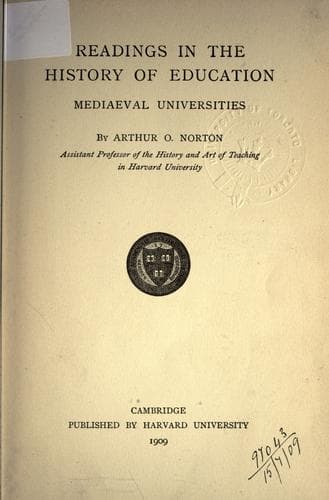
Readings in the History of Education: Mediaeval Universities — John Shaqi
Readings in the History of Education: Mediaeval UniversitiesNorton, Arthur O.
History
Readings in the History of Education: Mediaeval Universities
Norton, Arthur O.
Education, Medieval -- History -- Sources; Universities and colleges -- Europe
We have entrusted the entire task to Tribonianus, a most
distinguished man, Master of the Offices, ex-quaestor of our
sacred palace, and ex-consul, and we have laid on him the whole
service of the enterprise described, so that with other
illustrious and learned colleagues he might fulfil our desire.
[He is] to collect together and to submit to certain
modifications the very most important works of old times,
thoroughly intermixed and broken up as they may almost be called.
But in the midst of our careful researches, it was intimated to
us by the said exalted person that there were nearly two thousand
books written by the old lawyers, and more than three million
lines were left us by them, all of which it was requisite to read
and carefully consider and out of them to select whatever might
be best. [This was accomplished] so that everything of great
importance was collected into fifty books, and all ambiguities
were settled, without any refractory passage being left.[26]
In mediaeval university documents the Digest is frequently mentioned in
three divisions, which probably indicate three separate instalments in
which the MS. of the work was brought to Bologna in the eleventh and
twelfth centuries: the Old Digest (Digestum Vetus) Bks. I-XXIV, title
ii, Infortiatum Bks. XXIV, title iii-XXXVIII, title iii, and New Digest
(Digestum Novum) Bks. XXXVIII, title iv-L. The meaning of the term
Infortiatum is uncertain.
This distinction between the various parts of the Digest is
purely arbitrary.... The division must have originated in an
accidental separation of some archetypal MS.[27]
(3) The Institutes, in four books, an elementary text-book for students.
The purpose of the book was to afford a simple, clear, and trustworthy
introduction to the study of law, and to economize the student's time:
When we had arranged and brought into perfect harmony the
hitherto confused mass of imperial constitutions (i.e. the Code),
we then extended our care to the vast volumes of ancient law;
and, sailing as it were across the mid ocean, have now completed,
through the favour of heaven, a work that once seemed beyond hope
(i.e. the Digest).
Public-domain text, read in full here on John Shaqi.
Reviews
Reviews
No reviews yet
Be the first to share your thoughts on this work.
Join the Discussion
Join the discussion
Sign in to leave a comment or review.
Sign InorCreate an account