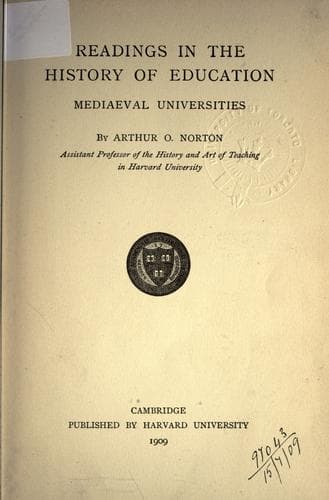
Readings in the History of Education: Mediaeval UniversitiesNorton, Arthur O.
History
Readings in the History of Education: Mediaeval Universities
Norton, Arthur O.
Education, Medieval -- History -- Sources; Universities and colleges -- Europe
The great compilation of the Roman Law known as the _Corpus Juris
Civilis_ (Body of Civil Law) constitutes a second important addition of
the twelfth century to the field of university studies. It was probably
more important as an influence upon the growth of universities than the
works of Aristotle.
The greater part of the Corpus Juris was compiled at Constantinople,
529-533 A.D., by certain eminent jurists under the Roman Emperor,
Justinian. The purpose of the work was to reduce to order and harmony
the mass of confused and contradictory statutes and legal opinions, and
to furnish a standard body of laws of manageable size in place of the
unwieldly mass of incorrect texts commonly in use, so that "the entire
ancient law, in a state of confusion for some fourteen hundred years and
now by us made clear, may be, so to speak, enclosed within a wall and
have nothing left outside it." The jurists entrusted with this work were
also required to prepare an introductory book for students, as described
below. After the completion of the whole work Justinian issued (533-565)
many new statutes (Novellae) which were never officially collected, but
which came to be considered a part of the Corpus Juris. The main
divisions of the Body of Civil Law are--
(1) The Code, in twelve books, which contains statutes of the Emperors
from the third century A.D.
Since [says Justinian] we find the whole course of our statutes
... to be in a state of such confusion that they reach to an
infinite length and surpass the bounds of all human capacity, it
was therefore our first desire to make a beginning with the most
sacred Emperors of old times, to amend their statutes, and to put
them in a clear order, so that they might be collected together
in one book, and, being divested of all superfluous repetition
and most inequitable disagreement, might afford to all mankind
the ready resource of their unalloyed character.[25]
(2) The Digest, or Pandects, in fifty books, containing extracts from
the opinions of Roman lawyers on a great variety of legal questions.
This work was also undertaken to bring order and harmony out of the
prevailing confusion:
Public-domain text, read in full here on John Shaqi.
Reviews
Reviews
No reviews yet
Be the first to share your thoughts on this work.
Join the Discussion
Join the discussion
Sign in to leave a comment or review.
Sign InorCreate an account