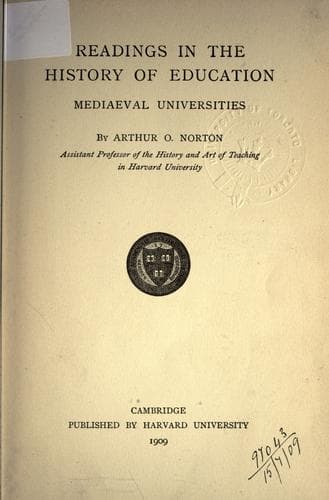
Readings in the History of Education: Mediaeval UniversitiesNorton, Arthur O.
History
Readings in the History of Education: Mediaeval Universities
Norton, Arthur O.
Education, Medieval -- History -- Sources; Universities and colleges -- Europe
Does he not seem to you to be walking in the vanity of the
senses, and in darkness of mind, who day and night torments
himself with the dialectic art; who, as an investigator of
nature, raises his eyes athwart the heavens and, beyond the
depths of lands and the abyss, is plunged into the so-called
void; who grows warm over iambics, who, in his over zealous mind,
analyses and combines the great jungle of metres; and, (to pass
to another phase of the matter), who seeks riches by fair means
and foul means, who fawns upon kings, grasps at the inheritances
of others, and amasses wealth though he knows not at the time to
whom he is going to leave it?
(_h_) In this thirty-seventh division Gratian asks[C] whether one who
is to be ordained ought to be acquainted with profane literature. First,
however, he shows that the clergy ought not to give attention to the
books of the heathen.[D] Then he gives the argument on the other side
and offers this solution, that some read the books of the heathen for
amusement and pleasure, and this is forbidden, while some read for
instruction, and this is lawful, in order that, through these books they
may know how to speak correctly and to distinguish the true from the
false. John, as far as "Then why" (p. 68). And notice that in all the
chapters up to "But on the other hand" (p. 64) pleasure alone seems to
be forbidden.
(_i_) Therefore they ought not to hear the laws, for it is a disgrace to
them if they wish to be versed in forensic training. C. de testa
consulta divalia. But, on the other hand, the laws are divinely
promulgated through the mouths of princes as XVI. quaest. III, nemo.[E]
Some say that it is lawful to hear the laws in order that through them
the canons may be better understood. He argues in favor of this division
in the section beginning "Some read profane literature" (p. 70). John.
(_k_) In order that they may know how to speak correctly.
Likewise [Jerome] on Isaiah:
He who misunderstands the sacred scriptures, or makes a wrong use
of profane wisdom, is drunken with wine[F] and with strong drink.
They are drunken with wine who (_l_) misunderstand the sacred
scriptures and pervert them, and through strong drink they make a
wrong use of profane wisdom and the wiles of the dialecticians,
which are to be called, not so much wiles as figures, that is,
symbols, so-called, and images, which quickly pass away and are
destroyed. Likewise, in accordance with tropology (_m_), we ought
to regard as false prophets those who interpret the words of the
scriptures otherwise than as the Holy Spirit utters them, and as
divine those who from the inferences of their own minds and apart
from the authority of divine words, proclaim as true the
uncertain events of the future. Likewise, those who do not
understand the Scriptures according to the actual truth eat sour
grapes.
Public-domain text, read in full here on John Shaqi.
Reviews
Reviews
No reviews yet
Be the first to share your thoughts on this work.
Elsewhere in the archive
Join the Discussion
Join the discussion
Sign in to leave a comment or review.
Sign InorCreate an account