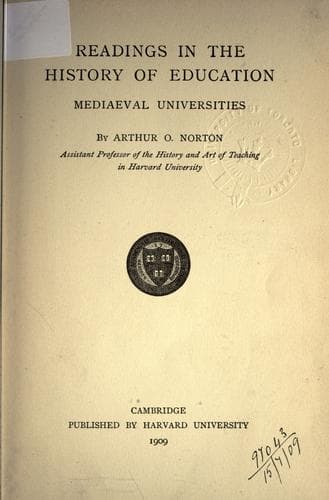
Readings in the History of Education: Mediaeval UniversitiesNorton, Arthur O.
History
Readings in the History of Education: Mediaeval Universities
Norton, Arthur O.
Education, Medieval -- History -- Sources; Universities and colleges -- Europe
He harms the mental acumen of readers, and causes it to wane, who
thinks that they should in every way be prevented from reading
profane books; for whatever useful things _(k)_ are found in them
it is lawful to adopt as one's own. Otherwise Moses and Daniel
would not have been allowed to become learned in the wisdom and
literature of the Egyptians and ...
(_h_) I.e. Ethics, natural philosophy, rational philosophy.
(_i_) Compared with other knowledge. John.
(_k_) He argues that the useful is not vitiated by the useless as XVII.
q. IV. questi s. dist. IX. si ad scripturas. Contra Joan.
...Chaldeans, whose superstitions and wantonness nevertheless
they shuddered at. And the teacher _(l)_ of the gentiles himself
would not have introduced _(m)_ some verses of the poets into his
own writings or sayings.
[On this Gratian comments:]
Then why[R] are those [writings] forbidden to be read which, it
...
(_l_) For we read that when Paul had come to Athens he saw an altar of
the Unknown God on which it was written: "This is an altar of[S] the
Unknown God in whom we live and move and have our being." And with this
inscription the Apostle began his exhortation and made known to those
Athenians the meaning of this inscription,--continuing about our God and
saying: "Whom you pronounce Unknown, Him declare I unto you and
worship." Then Dionysius,[T] the Areopagite, seeing a blind man passing
by said to him (i.e. Paul), "If you will give sight to that blind man I
will believe you." Immediately, when the name of Christ had been
invoked, he was restored to sight and Dionysius believed.
(_m_) E.g. In the Epistle of Paul to Titus,[U] the quotation from
Epimenides the poet: "The Cretians are always liars, evil beasts, slow
bellies." I. quaest, i. dominus declaravit.
Also he introduced in the first Epistle to the Corinthians this from
Menander: "Evil communications often corrupt good manners." XXVIII.
quaestio I. saepe.
He used also this verse: "I shall hate if I can: if not, I shall love
against my will." But Jerome in his fifth division on Consecration often
used verses from Virgil and Augustine, this of Lucan's: "Mens hausti
nulla" &c. XXVI. quaestio V. nee mirum. And, as a lawyer, he uses the
authority of Vergil, ff. de rerum divisione, intantrum Sec. cenotaphium;
and also, of Homer, insti. de Dontrahen. emp. Sec. pretium.
Public-domain text, read in full here on John Shaqi.
Reviews
Reviews
No reviews yet
Be the first to share your thoughts on this work.
Elsewhere in the archive
Join the Discussion
Join the discussion
Sign in to leave a comment or review.
Sign InorCreate an account