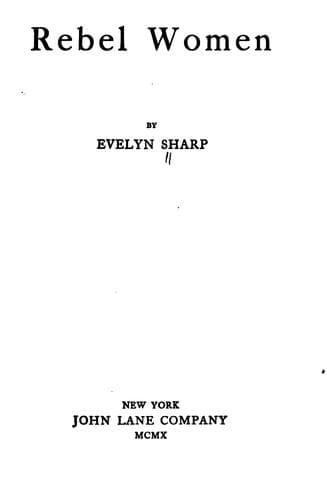
Women -- Great Britain -- Social conditions; Women -- Suffrage -- Great Britain
She stood there, looking at me fiercely, and the baby gave another
whimper to express its outraged sense of the fitness of things. There
was nothing heroic in the woman's figure; I think her hair was coming
down, and there was soot about her, and her blouse wore a general air of
bulgy disorder. At her feet lay strewn the symbols of inartistic toil, a
hairless stove broom, a cracked saucer with a mess of blacklead in it,
some indescribable bits of rag. Over it all hung the sickly smell of
stale, unventilated air, mingled with the fumes of damp and smouldering
wood. It was assuredly not the setting for a great situation. Yet, as
we stood there, looking at each other, in the little hush that fell upon
us after that outburst of the rebel mother, I found myself wondering if
I had ever known how great situations are made.
The baby struggled to escape from an embrace it did not understand; and,
of course, the baby was right. Mrs. Jim Bunce recognized the call of
convention, and acknowledged it by giving a sound scolding to those
portions of her family that happened to be within reach. The flues were
attacked afresh with tempestuous energy; the baby was left sobbing and
neglected in one corner, the sprawling boys scurried to another. I was
told as plainly as looks could tell that my place on a Saturday
afternoon was not the home.
I decided that this was not the moment to explain to Mrs. Jim Bunce that
an age was dawning in which women would be glad instead of afraid "to
bring another woman into it."
XII
The Daughter who stays at Home
"I suppose you think," Penelope threw at me with unnecessary vehemence,
"that it is only the daughter who lives away from home who is really a
rebel."
"On the contrary," I said, "most rebellion is bred in the home. Napoleon
said----"
"Oh, I know what Napoleon said," interrupted Penelope. "At least, I know
the kind of thing he must have said, if you want to quote it. Seriously,
I don't think you know what it feels like to be the daughter who comes
back to live at home, after being handicapped by a modern education. You
see, the daughter has gone on, and the home hasn't. It isn't mother's
fault, because she naturally thought she was fitting me for home life
when she let me take a college course in housewifery. But what is the
use of knowing all about the chemistry of cooking and the science of
house-cleaning, if you have to apply it in a home that has stayed in the
same place for a hundred years? Everything and everybody is against one,
from the abominable kitchen-range to the cook who has been with mother
ever since she was married. You are going to say Napoleon again."
"I was going to say," was the cautious reply she received to this, "that
the only victories which leave no regret are those that are gained over
ignorance."
"Who said that?" demanded Penelope suspiciously.
"Napoleon," I admitted.
Public-domain text, read in full here on John Shaqi.
Reviews
Reviews
No reviews yet
Be the first to share your thoughts on this work.
Join the Discussion
Join the discussion
Sign in to leave a comment or review.
Sign InorCreate an account