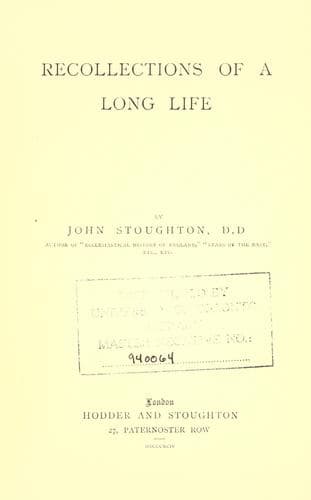
Clergy -- England -- Biography; Stoughton, John, 1807-1897
After we had spent some days at Elberfeld we started for Switzerland,
where I planned my wife and daughter should spend two or three weeks,
whilst accompanied by a Kensington friend, I proceeded on a journey to
Italy. We started from Zurich, crossed the lake, reached Coire and the
Via Mala, and over the Alps, came down to the Lake of Como; thence we
reached Milan, where we stayed three days. I then became acquainted for
the first time with the Duomo and other churches. We spent a Sunday in
the city, and felt deeply interested in schools founded by Cardinal
Borromeo, carried on at the time with exemplary care; and we found at
eventide, in a church, groups of worshippers, led by a layman, who knelt
in front as they chanted responses. I was struck then, and have been
oftentimes since, with the adaptation of Scripture passages on church
walls, pointing to salvation through our Lord Jesus Christ. One thought,
too, of Ambrose, who forbade the approach of Theodosius, wet with the
blood he had shed at Thessalonica. Speaking of the adaptation of
Scripture in foreign churches, I may mention other passages inscribed on
their walls in other places, for example, at Treves, where under a
picture of “The Nativity” we read “Verily Thou art a God that hidest
Thyself,” as applied to the Incarnation. Again, at Nismes, if I
recollect aright, under the fresco of a captive rejoicing in his freedom,
the words “Thou hast loosed my bonds”; and under another, representing
martyrs and virgins at the portals of heaven, “With joy and rejoicing
shall they be brought: they shall enter into the King’s palace.” After
all, the kernel of the Gospel continues in Roman Catholic Christendom,
though too often concealed under manifold innovations. Still there it
is, if you look for it.
My reference to Milan brings before me other recollections of that
wonderful city, as revisited again and again since 1852. Amidst manifold
associations of art, archæology, history, and religion, one image,
indelibly impressed on my mind, is that of Augustine under the fig tree
in a garden, listening to a voice which cried, “Tolle lege”; at the
hearing of which he sat down, took the Testament in his hand, and read
Rom. xiii., and thus became a new creature in Christ Jesus. Wandering in
quiet old streets, I have paused near some fig tree in a little enclosure
of grass and flowers, to think of him who became the grandest father of
the Latin Church.
From Milan we proceeded to Verona, and thence to Venice, where I felt
“one of the greatest emotions of life.” I have seen it again and again,
but the first charm was greatest of all. Then Titian’s “Peter Martyr”
adorned the walls of SS. Giovanni e Paulo. Wonderful picture that! but
it does not, to my mind, eclipse his S. Jerome in the Brera at Milan.
Let me return to Kensington. Perhaps this is as good a place as any, for
saying a few words about people there, and others with whom I was brought
into contact, during my pastorate.
Public-domain text, read in full here on John Shaqi.
Reviews
Reviews
No reviews yet
Be the first to share your thoughts on this work.
Elsewhere in the archive
Join the Discussion
Join the discussion
Sign in to leave a comment or review.
Sign InorCreate an account