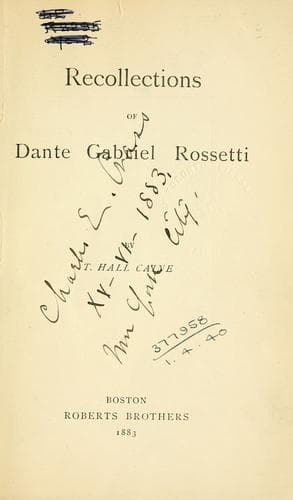
Recollections of Dante Gabriel RossettiCaine, Hall, Sir
Philosophy
Recollections of Dante Gabriel Rossetti
Caine, Hall, Sir
Rossetti, Dante Gabriel, 1828-1882
Thus was Rossetti already immersed in this revived occupation of poetic
composition, and had recovered a healthy* tone of body, before he became
conscious of what was being done with him. It is a further amusing fact
that one day he requested to be shown the first sonnet which, in view of
the praise lavished upon it by the friend on whose judgment he reposed,
had encouraged him to renewed effort. The sonnet was bad: the critic
knew it was bad, and had from the first hour of its production kept it
carefully out of sight, and was now more than ever unwilling to show it.
Eventually, however, by reason of ceaseless importunity, he returned it
to its author, who, upon reading it, cried: “You fraud! you said this
sonnet was good, and it’s the worst I _ever_ wrote.” “The worst ever
written would perhaps be a truer criticism,” was the reply, as the
studio resounded with a hearty laugh, and the poem was committed to the
flames. It would appear that to this occurrence we probably owe a large
portion of the contents of the volume of 1881.
As we say, _Rose Mary_ was the first to be written of the leading poems
that found places in his final volume. This ballad (or ballad romance,
for ballad it can hardly be called) is akin to _Sister Helen_ in
_motif_. The superstition involved owes something in this case as in
the other to the invention and poetic bias of the poet. It has, however,
less of what has been called the Catholic element, and is more purely
Pagan. It is, therefore, as entirely undisturbed by animosity against
heresy, and is concerned only with an ultimate demoniacal justice
visiting the wrongdoer. The main point of divergency lies in the
circumstance that Rose Mary, unlike Helen, is the undesigning instrument
of evil powers, and that her blind deed is the means by which her
own and her lover’s sin and his treachery become revealed. A further
material point of divergency lies in the fact that unlike Helen, who
loses her soul (as the price of revenge, directed against her betrayer),
Rose Mary loses her life (as the price of vengeance directed against
the evil race), whilst her soul gains rest. The superstition is that
associated with the beryl stone, wherein the pure only may read the
future, and from which sinful eyes must chase the spirits of grace and
leave their realm to be usurped by the spirits of fire, who seal up the
truth or reveal it by contraries. Rose Mary, who has sinned with her
lover, is bidden to look in the beryl and learn where lurks the ambush
that waits to take his life as he rides at break of day. Hiding, but
remembering her transgression, she at first shrinks, but at length
submits, and the blessed spirits by whom the stone has been tenanted
give place to the fiery train. The stone is not sealed to her; and the
long spell being ministered, she is satisfied. But she has read the
stone by contraries, and her lover falls into the hand of his enemy.
By his death is their secret sin made known. And then a newer shame is
Public-domain text, read in full here on John Shaqi.
Reviews
Reviews
No reviews yet
Be the first to share your thoughts on this work.
Elsewhere in the archive
Join the Discussion
Join the discussion
Sign in to leave a comment or review.
Sign InorCreate an account