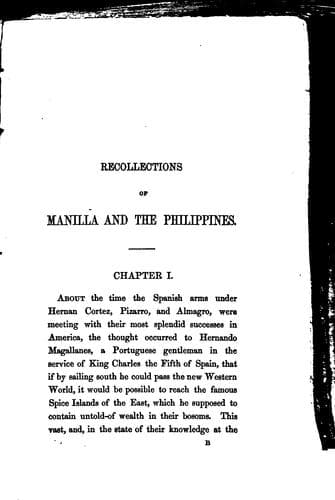
Recollections of Manilla and the Philippines: During 1848, 1849 and 1850MacMicking, Robert
History
Recollections of Manilla and the Philippines: During 1848, 1849 and 1850
MacMicking, Robert
Manila (Philippines); Philippines
breeding ducks, situated among the swamps at the outlets of the lake,
and the beginning of the river.
Several of these duck villages can scarcely be said to be situated on
_terra firma_, as many of the _nipa_ or attap-houses are founded on
the supporting trunks of trees growing out of the sedgy swamp. The
houses have a small lower platform of bamboo on two sides, for a
cooking-place and for landing from a boat, below and around being trees
or bamboos growing out of the water. Many of these clumps of bamboo,
some of which attain a great height, occasionally, perhaps, as much as
150 feet, are from their numbers a peculiar feature in the landscape
of the Philippines, and form some of the most beautiful objects of
luxuriant vegetation that can be imagined for a landscape. They are
found growing wild, very grand and fresh-looking in all parts of
the country, and are of many varieties, some of which any one may be
acquainted with who takes the trouble to consult the good old Padre
Blanco's book on the _flora de Filipinas_.
At the pateros, near the entrance to the Laguna, the people breed large
flocks of ducks to supply the Manilla market, to the exclusion of all
other employment except, perhaps, catching and drying enough fish to
season their rice, which most of them purchase, and very few of them
grow. These Indians, although few in number, are to a considerable
extent isolated from the people of the country, from what cause I
know not, but they very rarely associate or intermarry except with
each other. The ducks they breed for the market are well trained,
being perfectly obedient to the call of their different masters,
and on hearing his signal come quickly sailing back, should they have
gone too far away. They get fat on the fish and tender sedgy grass,
and when placed on the dinner-table are very good eating.
After entering the lake, which is studded with wooded islets, the
largest of which is named Talim, the gun is called into requisition,
as the immense flocks of wild duck breeding here afford a constant
sport, and the advantages of their acquisition are not likely to be
overlooked either by the _gourmand_ or the hungry tourist. They are,
however, rather wild, and the best mode of shooting them appears
to be to dress in a blue cotton shirt and trousers like an Indian,
and paddle off as near the flock as they will permit; and then for a
chance among them. If there is more than one person in the grass-boat,
which is a very small and unhooded banca, which the natives use for
carrying small quantities of grass for horses, &c., the ducks are
apt to take the alarm, although I have sometimes been successful in
getting near them with an Indian paddling the boat.
Public-domain text, read in full here on John Shaqi.
Reviews
Reviews
No reviews yet
Be the first to share your thoughts on this work.
Elsewhere in the archive
Join the Discussion
Join the discussion
Sign in to leave a comment or review.
Sign InorCreate an account