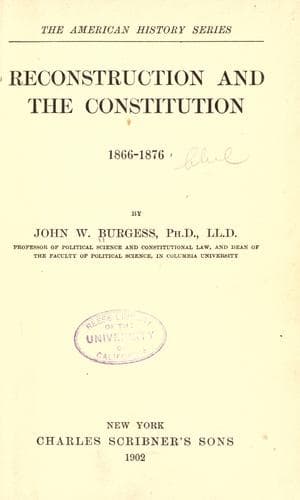
Reconstruction and the Constitution, 1866-1876Burgess, John William
History
Reconstruction and the Constitution, 1866-1876
Burgess, John William
Reconstruction (U.S. history, 1865-1877); United States -- Politics and government -- 1865-1877
They, therefore, resolved to nip the plan in the bud by preventing the
assembly of the convention, or forcing it to disperse if it did
assemble. The mayor of the city, Mr. Monroe, the same who was mayor
when the Union army entered the city in 1862, applied to the General in
command of the United States troops in Louisiana, General Absalom
Baird, to know what attitude the military authorities would take toward
the convention, and informed General Baird that he intended to disperse
the convention if it should attempt to assemble without having the
approval of these authorities. General Baird was acting for General
Sheridan, who was absent from his post, and he replied with much more
caution than he would probably have done had he been alone responsible.
He told Mayor Monroe that he thought the Governor of the "State,"
rather than the mayor of the city, was the man to interfere with the
assembly of a body professing to be a "State" convention, if there was
to be any interference at all, and he gave the mayor to understand that
his proposed course might be perilous. This was the {95} 25th of July.
Two days later the mayor went again to the General, this time
accompanied by the Lieutenant-Governor, who was of the party of the
amnestied. He now told General Baird that the police would not
undertake to prevent the assembly of the convention, or disperse its
members when assembled, but that its members would be indicted by the
grand jury and arrested by the sheriff. The General seemed to think
that the convention could lawfully assemble, but agreed with the mayor
and Lieutenant-Governor that both he and they would request
instructions from Washington.
The General applied to the Secretary of War, and the mayor applied to
the President. The General informed the Secretary of the movement to
assemble a convention; that it had the approval of the Governor; that
the Lieutenant-Governor and the municipal authorities considered it
unlawful and proposed to prevent it by arresting the delegates; that he
had declared to them that he would not permit them to do this, unless
the President should so instruct him; and he asked for orders, in the
premises, by telegraph. The Lieutenant-Governor and the
Attorney-General of the "State" informed the President of the movement
to assemble the old convention; informed him that negroes were
assembling, incendiary speeches were being made calling them to arm
themselves, and the President was being denounced; that the Governor
was in sympathy with the movement; that the matter was before the grand
jury; and that it was contemplated to have the members of the
convention arrested by criminal process; and they asked the President
to inform them whether the military authorities would interfere to
prevent the execution of the processes of the criminal court.
Public-domain text, read in full here on John Shaqi.
Reviews
Reviews
No reviews yet
Be the first to share your thoughts on this work.
Elsewhere in the archive
Join the Discussion
Join the discussion
Sign in to leave a comment or review.
Sign InorCreate an account