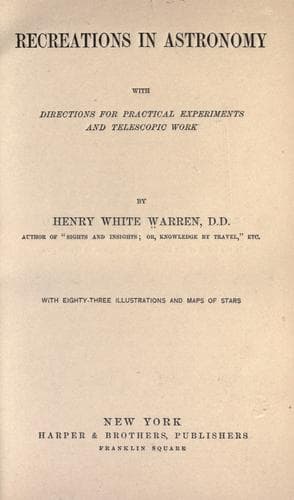
Recreations in Astronomy: With Directions for Practical Experiments and Telescopic WorkWarren, Henry White
Religion
Recreations in Astronomy: With Directions for Practical Experiments and Telescopic Work
Warren, Henry White
Astronomy
Concerning the condition of the surface of the sun many opinions
are held. That it is hot beyond all estimate is indubitable. Whether
solid or gaseous we are not sure. Opinions differ: some incline to
the first theory, others to the second; some deem the sun composed
of solid particles, floating in gas so condensed [Page 90] by
pressure and attraction as to shine like a solid. It has no sensible
changes of general level, but has prodigious activity in spots.
These spots have been the objects of earnest and almost hourly study
on the part of such men as Secchi, Lockyer, Faye, Young, and others,
for years. But it is a long way off to study an object. No telescope
brings it nearer than 200,000 miles. Theory after theory has been
advanced, each one satisfactory in some points, none in all. The
facts about the spots are these: They are most abundant on the two
sides of the equator. They are gregarious, depressed below the
surface, of vast extent, black in the centre, usually surrounded by
a region of partial darkness, beyond which is excessive light. They
have motion of their own over the surface--motion rotating about an
axis, upward and downward about the edges. They change their
apparent shape as the sun carries them across its disk by axial
revolution, being narrow as they present their edges to us, and
rounder as we look perpendicularly into them (Fig. 35).
[Illustration: Fig. 35.--Change in Spots as rotated across the Disk,
showing Cavities.]
These spots are also very variable in number, sometimes there being
none for nearly two hundred days, and again whole years during which
the sun is never without them. The period from minimum to maximum
[Page 91] of spots is about eleven years. We might look for them
again and again in vain this year (1878). They will be most numerous
in 1882 and 1893. The cause of this periodicity was inferred to be
the near approach of the enormous planet Jupiter, causing
disturbance by its attraction. But the periods do not correspond,
and the cause is the result of some law of solar action to us as yet
unknown.
These spots may be seen with almost any telescope, the eye being
protected by deeply colored glasses.
Until within one hundred years they were supposed to be islands of
scoriæ floating in the sea of molten matter. But they were depressed
below the surface, and showed a notch when on the edge. Wilson
originated and Herschel developed the theory that the sun's real
body was dark, cool, and habitable, and that the photosphere was
a luminous stratum at a distance from the real body, with openings
showing the dark spots below. Such a sun would have cooled off in
a week, but would previously have annihilated all life below.
Public-domain text, read in full here on John Shaqi.
Reviews
Reviews
No reviews yet
Be the first to share your thoughts on this work.
Elsewhere in the archive
Join the Discussion
Join the discussion
Sign in to leave a comment or review.
Sign InorCreate an account