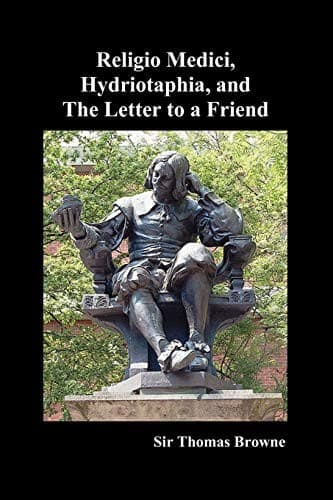
Religio Medici, Hydriotaphia, and the Letter to a FriendBrowne, Thomas, Sir
Religion
Religio Medici, Hydriotaphia, and the Letter to a Friend
Browne, Thomas, Sir
Christian ethics; Christian life; Essays; Funeral rites and ceremonies; Medical ethics; Medicine -- History; Religion and medicine
_Sect._ 39.--Some divines[52] count Adam thirty years old at his
creation, because they suppose him created in the perfect age and
stature of man: and surely we are all out of the computation of our
age; and every man is some months older than he bethinks him; for
we live, move, have a being, and are subject to the actions of the
elements, and the malice of diseases, in that other world, the truest
microcosm, the womb of our mother; for besides that general and common
existence we are conceived to hold in our chaos, and whilst we sleep
within the bosom of our causes, we enjoy a being and life in three
distinct worlds, wherein we receive most manifest gradations. In that
obscure world, the womb of our mother, our time is short, computed
by the moon; yet longer than the days of many creatures that behold
the sun; ourselves being not yet without life, sense, and reason;[53]
though, for the manifestation of its actions, it awaits the opportunity
of objects, and seems to live there but in its root and soul of
vegetation. Entering afterwards upon the scene of the world, we arise
up and become another creature; performing the reasonable actions
of man, and obscurely manifesting that part of divinity in us, but
not in complement and perfection, till we have once more cast our
secundine, that is, this slough of flesh, and are delivered into the
last world, that is, that ineffable place of Paul, that proper _ubi_
of spirits. The smattering I have of the philosopher’s stone (which is
something more than the perfect exaltation[54] of gold) hath taught me
a great deal of divinity, and instructed my belief, how that immortal
spirit and incorruptible substance of my soul may lie obscure, and
sleep a while within this house of flesh. Those strange and mystical
transmigrations that I have observed in silkworms turned my philosophy
into divinity. There is in these works of nature, which seem to puzzle
reason, something divine; and hath more in it than the eye of a common
spectator doth discover.
Public-domain text, read in full here on John Shaqi.
Reviews
Reviews
No reviews yet
Be the first to share your thoughts on this work.
Join the Discussion
Join the discussion
Sign in to leave a comment or review.
Sign InorCreate an account