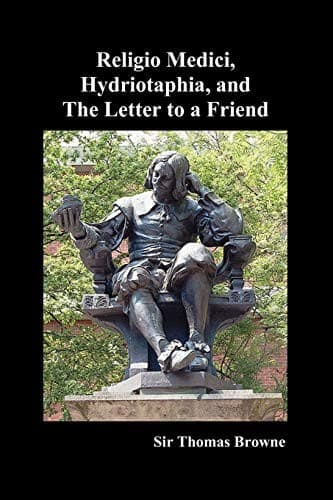
Religio Medici, Hydriotaphia, and the Letter to a FriendBrowne, Thomas, Sir
Religion
Religio Medici, Hydriotaphia, and the Letter to a Friend
Browne, Thomas, Sir
Christian ethics; Christian life; Essays; Funeral rites and ceremonies; Medical ethics; Medicine -- History; Religion and medicine
_Sect._ 40.--I am naturally bashful; nor hath conversation, age, or
travel, been able to effront or enharden me; yet I have one part of
modesty, which I have seldom discovered in another, that is (to speak
truly), I am not so much afraid of death as ashamed thereof; ’tis
the very disgrace and ignominy of our natures, that in a moment can
so disfigure us, that our nearest friends, wife, and children, stand
afraid, and start at us. The birds and beasts of the field, that
before, in a natural fear, obeyed us, forgetting all allegiance, begin
to prey upon us. This very conceit hath, in a tempest, disposed and
left me willing to be swallowed up in the abyss of waters, wherein I
had perished unseen, unpitied, without wondering eyes, tears of pity,
lectures of mortality, and none had said, “_Quantum mutatus ab illo!_”
Not that I am ashamed of the anatomy of my parts, or can accuse nature
of playing the bungler in any part of me, or my own vicious life for
contracting any shameful disease upon me, whereby I might not call
myself as wholesome a morsel for the worms as any.
_Sect._ 41.--Some, upon the courage of a fruitful issue, wherein,
as in the truest chronicle, they seem to outlive themselves, can
with greater patience away with death. This conceit and counterfeit
subsisting in our progenies seems to be a mere fallacy, unworthy the
desire of a man, that can but conceive a thought of the next world;
who, in a nobler ambition, should desire to live in his substance in
heaven, rather than his name and shadow in the earth. And therefore,
at my death, I mean to take a total adieu of the world, not caring for
a monument, history, or epitaph; not so much as the bare memory of my
name to be found anywhere, but in the universal register of God. I am
not yet so cynical, as to approve the testament of Diogenes,[J] nor do
I altogether allow that rodomontado of Lucan;[K]
[J] Who willed his friend not to bury him, but to hang him up with a
staff in his hand, to fright away the crows.
[K] “Pharsalia,” vii. 819.
-----“_Cœlo tegitur, qui non habet urnam._”
He that unburied lies wants not his hearse;
For unto him a tomb’s the universe.
Public-domain text, read in full here on John Shaqi.
Reviews
Reviews
No reviews yet
Be the first to share your thoughts on this work.
Join the Discussion
Join the discussion
Sign in to leave a comment or review.
Sign InorCreate an account