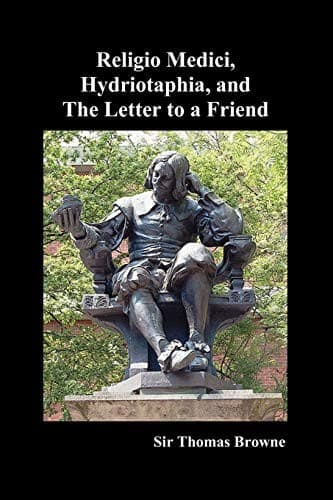
Religio Medici, Hydriotaphia, and the Letter to a FriendBrowne, Thomas, Sir
Religion
Religio Medici, Hydriotaphia, and the Letter to a Friend
Browne, Thomas, Sir
Christian ethics; Christian life; Essays; Funeral rites and ceremonies; Medical ethics; Medicine -- History; Religion and medicine
_Sect._ 55.--Nor truly do I think the lives of these, or of any other,
were ever correspondent, or in all points conformable, unto their
doctrines. It is evident that Aristotle transgressed the rule of his
own ethicks;[70] the stoicks, that condemn passion, and command a man
to laugh in Phalaris’s[71] bull, could not endure without a groan a
fit of the stone or colick. The scepticks, that affirmed they knew
nothing,[72] even in that opinion confute themselves, and thought
they knew more than all the world beside. Diogenes I hold to be the
most vainglorious man of his time, and more ambitious in refusing all
honours, than Alexander in rejecting none. Vice and the devil put a
fallacy upon our reasons; and, provoking us too hastily to run from
it, entangle and profound us deeper in it. The duke of Venice, that
weds himself unto the sea, by a ring of gold,[73] I will not accuse of
prodigality, because it is a solemnity of good use and consequence in
the state: but the philosopher, that threw his money into the sea to
avoid avarice, was a notorious prodigal.[74] There is no road or ready
way to virtue; it is not an easy point of art to disentangle ourselves
from this riddle or web of sin. To perfect virtue, as to religion,
there is required a _panoplia_, or complete armour; that whilst we
lie at close ward against one vice, we lie not open to the veney[75]
of another. And indeed wiser discretions, that have the thread of
reason to conduct them, offend without a pardon; whereas under heads
may stumble without dishonour. There go so many circumstances to
piece up one good action, that it is a lesson to be good, and we are
forced to be virtuous by the book. Again, the practice of men holds
not an equal pace, yea and often runs counter to their theory; we
naturally know what is good, but naturally pursue what is evil: the
rhetorick wherewith I persuade another cannot persuade myself. There
is a depraved appetite in us, that will with patience hear the learned
instructions of reason, but yet perform no further than agrees to
its own irregular humour. In brief, we all are monsters; that is, a
composition of man and beast: wherein we must endeavour to be as the
poets fancy that wise man, Chiron; that is, to have the region of
man above that of beast, and sense to sit but at the feet of reason.
Lastly, I do desire with God that all, but yet affirm with men that
few, shall know salvation,--that the bridge is narrow, the passage
strait unto life: yet those who do confine the church of God either to
particular nations, churches, or families, have made it far narrower
than our Saviour ever meant it.
Public-domain text, read in full here on John Shaqi.
Reviews
Reviews
No reviews yet
Be the first to share your thoughts on this work.
Elsewhere in the archive
Join the Discussion
Join the discussion
Sign in to leave a comment or review.
Sign InorCreate an account