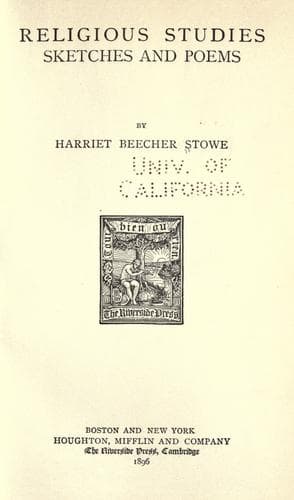
Religious Studies, Sketches and PoemsStowe, Harriet Beecher
Religion
Religious Studies, Sketches and Poems
Stowe, Harriet Beecher
Religion
We are struck, in the history of our Lord, with the unworldliness
of his manner of living his daily life and fulfilling his great
commission. It is emphatically true, in the history of Jesus, that
his ways are not as our ways, and his thoughts as our thoughts.
He did not choose the disciples of his first ministry as worldly
wisdom would have chosen them. Though men of good and honest hearts,
they were neither the most cultured nor the most influential of his
nation. We should have said that men of the standing of Joseph of
Arimathea or Nicodemus were preferable, other things being equal, to
Peter the fisherman or Matthew the tax-gatherer; but Jesus thought
otherwise.
And, furthermore, he sometimes selected those apparently most
unlikely to further his ends. Thus, when he had a mission of mercy
in view for Samaria, he called to the work a woman; not such as we
should suppose a divine teacher would choose,--not a preëminently
intellectual or a very good woman,--but, on the contrary, one of a
careless life, and loose morals, and little culture. The history
of this person, of the way in which he sought her acquaintance,
arrested her attention, gained access to her heart, and made of
her a missionary to draw the attention of her people to him, is
wonderfully given by St. John. We have the image of a woman--such
as many are, social, good-humored, talkative, and utterly without
any high moral sense--approaching the well, where she sees this
weary Jew reclining to rest himself. He introduces himself to her
acquaintance by asking a favor,--the readiest way to open the heart
of a woman of that class. She is evidently surprised that he will
speak to her, being a Jew, and she a daughter of a despised and
hated race. "How is it," she says, "that thou, a Jew, askest drink
of me, a woman of Samaria?" Jesus now answers her in that symbolic
and poetic strain which was familiar with him: "If thou knewest
the gift of God, and who this is that asketh drink of thee, thou
wouldst ask of him, and he would give thee living water." The woman
sees in this only the occasion for a lively rejoinder: "Sir, thou
hast nothing to draw with, and the well is deep; from whence then
hast thou that living water?" With that same mysterious air, as if
speaking unconsciously from out some higher sphere, he answers,
"Whosoever drinketh of this water shall thirst again; but whosoever
shall drink of the water that I shall give shall never thirst. The
water that I shall give shall be a well in him springing up to
everlasting life."
Public-domain text, read in full here on John Shaqi.
Reviews
Reviews
No reviews yet
Be the first to share your thoughts on this work.
Join the Discussion
Join the discussion
Sign in to leave a comment or review.
Sign InorCreate an account