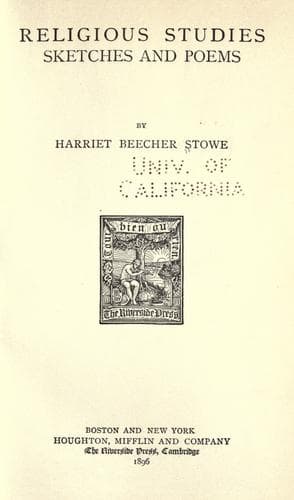
Religious Studies, Sketches and PoemsStowe, Harriet Beecher
Religion
Religious Studies, Sketches and Poems
Stowe, Harriet Beecher
Religion
The tradition of the church that Mary Magdalene was an enthusiastic
preacher of Jesus seems in keeping with all we know of the strength
and fervor of her character. Such love must find expression, and
we are told that when the first persecution scattered the little
church at Jerusalem, "they that were scattered went everywhere,
preaching the word." Some of the most effective preaching of
Christ is that of those who testify in their own person of a great
salvation. "He can save to the uttermost, for he has saved me," is
a testimony that often goes more straight to the heart than all the
arguments of learning. Christianity had this peculiarity over all
other systems, that it not only forgave the past, but made of its
bitter experiences a healing medicine; so that those who had sinned
deepest might have therefrom a greater redeeming power. "When thou
art converted, strengthen thy brethren," was the watchword of the
penitent.
The wonderful mind of Goethe has seized upon and embodied this
peculiarity of Christianity in his great poem of "Faust." The first
part shows the Devil making of the sweetest and noblest affection of
the confiding Margaret a cruel poison to corrupt both body and soul.
We see her driven to crime, remorse, shame, despair, all human forms
and forces of society united to condemn her, when with a last cry
she stretches her poor hands to heaven and says, "Judgment of God, I
commend myself to you;" and then falls a voice from heaven, "She is
judged; she is saved."
In the second part we see the world-worn, weary Faust passing
through the classic mythology, vainly seeking rest and finding
none; he seeks rest in a life of benevolence to man, but fiends
of darkness conflict with his best aspirations, and dog his steps
through life, and in his dying hour gather round to seize his soul
and carry it to perdition. But around him is a shining band. Mary
the mother of Jesus with a company of purified penitents encircle
him, and his soul passes, in infantine weakness, to the guardian
arms of Margaret,--once a lost and ruined woman, now a strong and
pitiful angel,--who, like a tender mother, leads the new-born soul
to look upon the glories of heaven, while angel voices sing to the
victory of good over evil:--
"All that is transient
Is but a parable;
The unattainable
Here is made real.
The indescribable
Here is accomplished;
The eternal womanly
Draws us upward and onward."
XV
THE REVEALER OF GOD'S SYMPATHY
The interest inspired by the wonderful character of Jesus rests
especially on those incidents which are most purely human, his
private, personal friendships, his keen sympathy with the suffering
and the afflicted. Among these incidents the story and characters
of the two sisters, Martha and Mary, have been set before us with
a fine individualism of dramatic representation that seems to make
them real to us, even at this distance of time.
Public-domain text, read in full here on John Shaqi.
Reviews
Reviews
No reviews yet
Be the first to share your thoughts on this work.
Elsewhere in the archive
Join the Discussion
Join the discussion
Sign in to leave a comment or review.
Sign InorCreate an account