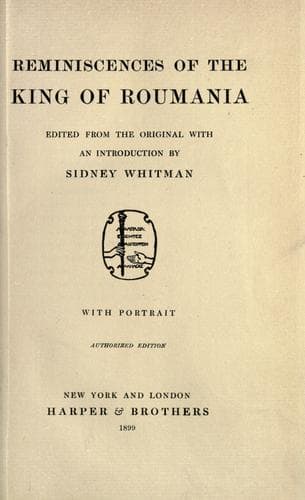
Reminiscences of the King of Roumania — John Shaqi
Reminiscences of the King of RoumaniaKremnitz, Mite
History
Reminiscences of the King of Roumania
Kremnitz, Mite
Carol I, King of Romania, 1839-1914; Eastern question (Balkan); Jews -- Romania; Romania -- History -- Charles I, 1866-1914
The repeated attacks of Austria, or rather of Count Beust, on
the Golesku Ministry and on Bratianu in particular, proved that
the retention of the latter might lead to the most serious
consequences. The nature of these attacks may be recognised from
the misstatements in the Austrian Red Book, which estimated the
number of needle-guns sold to Prince Charles at 50,000 instead of
10,000, whilst Roumania was termed an "arsenal" by Count Beust.
Shortly after the opening of the Chamber the Ministry resigned, and
Prince D. Ghika was entrusted with the formation of a new Ministry.
The most prominent member was M. Cogalniceanu, and the Ministry
was composed of statesmen belonging to every political party. In
a letter to the President Prince Charles praised his programme
as truly national, and expressed the hope that he would succeed
in effacing all differences of opinion and those intrigues so
prejudicial to the interests of the State.
On December 9, 1868, the following letter was received from Prince
Charles Anthony:
"The candidature for the Spanish throne has hitherto been
discussed only in newspapers; we have not ourselves heard a
single word about it, and even should this project be placed
more closely before us, I should never counsel the acceptance of
this hazardous though dazzling position. Moreover, France would
never be able to consent to the establishment of a Hohenzollern
on the other side of the Pyrenees on account of our relations
with Prussia; nay, it is already swollen with jealousy because
a member of that house rules the Lower Danube....
"Bismarck appears to me just now to possess rather less
influence in Home questions.... In the Foreign Office, however,
he continues undisturbed, although even there he has often to
bow to the views of the King."
In a subsequent letter to his son congratulating him on the
excellent results of the change in the Ministry, Prince Charles
Anthony wrote:
"England, which now possesses a new Ministry, must be managed
with tact, for the independence of the Porte is the _corde
sensible_ of both Tories and Whigs. If England is convinced that
Roumania does not wish to emancipate herself, you will be able
to reckon with confidence on England's sympathy and friendship
for Roumania."
Since Greece on December 18 declined to accept the Turkish
ultimatum, all Greek subjects living in Turkey were informed that
they would have to leave the country in fourteen days' time, and
a Conference assembled in Paris for the purpose of adjusting the
differences of these two nations and preventing a war. Their efforts
were crowned with success, for Greece accepted the declaration of
the Conference on February 6, 1869.
Public-domain text, read in full here on John Shaqi.
Reviews
Reviews
No reviews yet
Be the first to share your thoughts on this work.
Join the Discussion
Join the discussion
Sign in to leave a comment or review.
Sign InorCreate an account