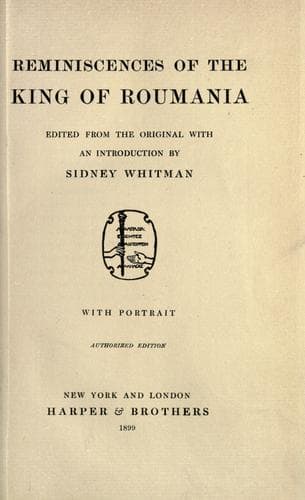
Reminiscences of the King of RoumaniaKremnitz, Mite
History
Reminiscences of the King of Roumania
Kremnitz, Mite
Carol I, King of Romania, 1839-1914; Eastern question (Balkan); Jews -- Romania; Romania -- History -- Charles I, 1866-1914
Continuing his journey by carriage the next morning, Prince Charles
reached Livadia at five in the afternoon after a long and fatiguing
drive. The Czar received him with the greatest cordiality, and
remarked at once that the courteous attitude of the Prince was
enough to attract the animosity of the whole of Europe. The
conversation then turned upon the affairs of Roumania, about which
the Czar showed himself well informed on every point. Prince Charles
was then presented to the Czarina, a cousin of his mother, to the
Grand Duchess Marie, and later on to the Czarevitch and his wife, as
well as to the Grand Duke Alexis. Unfortunately the tropical heat
affected both the Czar and his guest to no slight degree, and the
pleasure of the meeting was thus materially discounted. As early
as August 22 Prince Charles was forced to bid his hospitable hosts
good-bye, that he might attend the Roumanian manœuvres before his
visit to his parents in Germany.
The fears, which had been openly expressed, for the safety of
Roumania during the Prince's absence proved to have been utterly
unfounded, for, though the papers, the _Romanul_ and the _Trajan_,
emulated each other in their attacks upon the dynasty, their
revolutionary efforts met with no response at all, and it was
therefore with a light heart that Prince Charles set out on
September 7 to rejoin his dearly loved parents in South Germany.
Before he quitted the territory of Roumania an amnesty was granted
for all political and Press offences, in order to show the Prince's
confidence that no intrigue was able to shake his hold upon the
hearts of his people.
The journey to the West, which was to exert so potent an influence
on the Prince's life, was broken first at Vienna, where the Emperor
of Austria had announced his intention of receiving the Roumanian
Prince. For the first time since the war of 1866 the Emperor wore
the ribbon of the Black Eagle, as a compliment to the house of
Hohenzollern. Prince Charles seized the opportunity of assuring his
Majesty that it would always be the policy of Roumania to stand on
the best terms with Austria. Count Beust, who ventured to remark
that the cost of the Roumanian Army was out of all proportion to its
Budget, received the apt retort that the arsenals were unfortunately
empty, a reference to the Count's statement that "Roumania was
simply a large arsenal." The reception accorded to the Prince
was so hearty that the Viennese Press expressed the opinion that
Prince Charles would later on have to answer to the Porte for his
assumption of sovereign bearing.
Public-domain text, read in full here on John Shaqi.
Reviews
Reviews
No reviews yet
Be the first to share your thoughts on this work.
Elsewhere in the archive
Join the Discussion
Join the discussion
Sign in to leave a comment or review.
Sign InorCreate an account