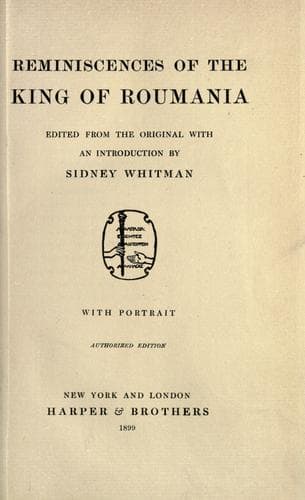
Reminiscences of the King of RoumaniaKremnitz, Mite
History
Reminiscences of the King of Roumania
Kremnitz, Mite
Carol I, King of Romania, 1839-1914; Eastern question (Balkan); Jews -- Romania; Romania -- History -- Charles I, 1866-1914
Only a few days remained before the stern call of duty summoned
the happy pair to their life-work in Roumania. The journey to the
Princess's new home in Bucharest was commenced on November 18. After
a short stay in Vienna the travellers reached Roumanian territory
on the 22nd. Every town through which they passed was profusely
decorated, and the enthusiasm of the Roumanian nation appeared to
surpass even that with which they had welcomed Prince Charles on
his accession. A hundred and one guns announced the arrival of
the Prince and Princess in Bucharest, and the town had put on all
its finery in honour of the occasion. After a _Te Deum_ had been
celebrated by the venerable Metropolitan Niphon, fifty happy couples
who had been married at the cost of the State defiled past their
Highnesses.
The following day deputations from all parts of the country were
received in the throne-room, when the Princess wore for the first
time the diamond coronet presented by the people of Bucharest.
Princess Elisabeth at once commenced to take an active share in her
husband's labours, and visited with him the various charitable and
educational establishments in the capital. The innate generosity
and liberality of the Prince had, however, made such inroads upon
his purse, that many of their cherished designs had to be abandoned
for the time being for lack of funds. At this moment, however,
the most prominent members of the Chamber were on the point of
introducing a measure granting the Princess a yearly sum of £12,000,
but Prince Charles declined to accept this offer until the financial
situation of Roumania had improved. The Opposition at once seized
the opportunity of representing such a proposal as a "robbery," and
their organs vied with each other in the most violent and unworthy
attacks on the Prince and Princess. Some even lowered themselves
so far as to send the grossest of these attacks to the Princess in
registered letters! The violent scenes and the obstruction in the
Chamber left the Budget unvoted, and again placed the Ministry in
a most unenviable position, from which they were only released by
their resignation in February 1870.
The new Ministry under A. Golesku displayed its weakness from the
day of its formation. The Opposition openly used threats such
as: "This dynasty cannot be endured," "Golesku will be the last
of Prince Charles's Ministers," and declared that a "bloody
tragedy" would shortly be enacted in the streets of the capital.
A far-spreading conspiracy against the peace of the country made
itself the more felt, since there were no police worthy of the name;
the National Guard also was a source of real danger, whilst the
apathy of the Ministry permitted these evils to flourish unchecked.
Public-domain text, read in full here on John Shaqi.
Reviews
Reviews
No reviews yet
Be the first to share your thoughts on this work.
Elsewhere in the archive
Join the Discussion
Join the discussion
Sign in to leave a comment or review.
Sign InorCreate an account