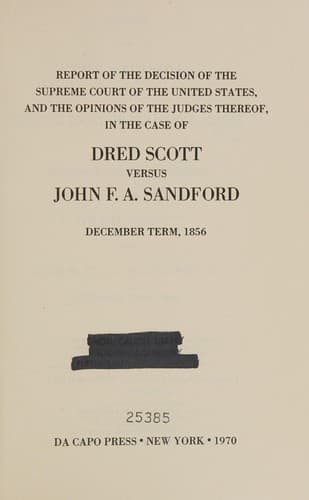
Report of the Decision of the Supreme Court of the United States, and the Opinions of the Judges Thereof, in the Case of Dred Scott versus John F. A. Sandford: December Term, 1856.United States. Supreme Court
History
Report of the Decision of the Supreme Court of the United States, and the Opinions of the Judges Thereof, in the Case of Dred Scott versus John F. A. Sandford: December Term, 1856.
United States. Supreme Court
Scott, Dred, 1809-1858; Slavery -- United States
Judge Story, in his letter in reply, observes: "I have read with great
attention your judgment in the slave case, &c. Upon the fullest
consideration which I have been able to give the subject, I entirely
concur in your views. If I had been called upon to pronounce a
judgment in a like case, I should have certainly arrived at the same
result." Again he observes: "In my native State, (Massachusetts,) the
state of slavery is not recognised as legal; and yet, if a slave
should come hither, and afterwards return to his own home, we should
certainly think that the local law attached upon him, and that his
servile character would be redintegrated."
We may remark, in this connection, that the case before the Maryland
court, already referred to, and which was decided in 1799, presented
the same question as that before Lord Stowell, and received a similar
decision. This was nearly thirty years before the decision in that
case, which was in 1828. The Court of Appeals observed, in deciding
the Maryland case, that "however the laws of Great Britain in such
instances, operating upon such persons there, might interfere so as to
prevent the exercise of certain acts by the masters, not permitted, as
in the case of Somersett, yet, upon the bringing Ann Joice into this
State, (then the province of Maryland,) the relation of master and
slave continued in its extent, as authorized by the laws of this
State." And Luther Martin, one of the counsel in that case, stated, on
the argument, that the question had been previously decided the same
way in the case of slaves returning from a residence in Pennsylvania,
where they had become free under her laws.
The State of Louisiana, whose courts had gone further in holding the
slave free on his return from a residence in a free State than the
courts of her sister States, has settled the law, by an act of her
Legislature, in conformity with the law of the court of Missouri in
the case before us. (Sess. Law, 1846.)
The case before Lord Stowell presented much stronger features for
giving effect to the law of England in the case of the slave Grace
than exists in the cases that have arisen in this country, for in that
case the slave returned to a colony of England over which the Imperial
Government exercised supreme authority. Yet, on the return of the
slave to the colony, from a temporary residence in England, he held
that the original condition of the slave attached. The question
presented in cases arising here is as to the effect and operation to
be given to the laws of a foreign State, on the return of the slave
within an independent sovereignty.
Upon the whole, it must be admitted that the current of authority,
both in England and in this country, is in accordance with the law as
declared by the courts of Missouri in the case before us, and we think
the court below was not only right, but bound to follow it.
Public-domain text, read in full here on John Shaqi.
Reviews
Reviews
No reviews yet
Be the first to share your thoughts on this work.
Join the Discussion
Join the discussion
Sign in to leave a comment or review.
Sign InorCreate an account