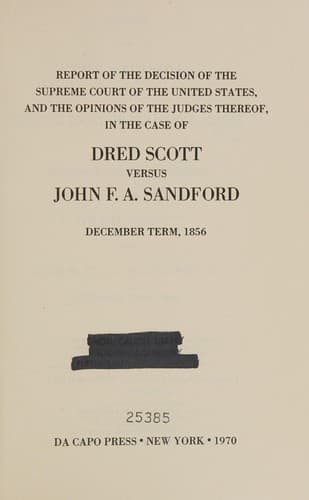
Report of the Decision of the Supreme Court of the United States, and the Opinions of the Judges Thereof, in the Case of Dred Scott versus John F. A. Sandford: December Term, 1856. — John Shaqi
Report of the Decision of the Supreme Court of the United States, and the Opinions of the Judges Thereof, in the Case of Dred Scott versus John F. A. Sandford: December Term, 1856.United States. Supreme Court
History
Report of the Decision of the Supreme Court of the United States, and the Opinions of the Judges Thereof, in the Case of Dred Scott versus John F. A. Sandford: December Term, 1856.
United States. Supreme Court
Scott, Dred, 1809-1858; Slavery -- United States
Some question has been made as to the character of the residence in
this case in the free State. But we regard the facts as set forth in
the agreed case as decisive. The removal of Dr. Emerson from Missouri
to the military posts was in the discharge of his duties as surgeon in
the army, and under the orders of his Government. He was liable at any
moment to be recalled, as he was in 1838, and ordered to another post.
The same is also true as it respects Major Taliaferro. In such a case,
the officer goes to his post for a temporary purpose, to remain there
for an uncertain time, and not for the purpose of fixing his permanent
abode. The question we think too plain to require argument. The case
of the Attorney General _v._ Napier, (6 Welsh, Hurtst. and Gordon
Exch. Rep., 217,) illustrates and applies the principle in the case of
an officer of the English army.
A question has been alluded to, on the argument, namely: the right of
the master with his slave of transit into or through a free State, on
business or commercial pursuits, or in the exercise of a Federal
right, or the discharge of a Federal duty, being a citizen of the
United States, which is not before us. This question depends upon
different considerations and principles from the one in hand, and
turns upon the rights and privileges secured to a common citizen of
the republic under the Constitution of the United States. When that
question arises, we shall be prepared to decide it.
Our conclusion is, that the judgment of the court below should be
affirmed.
* * * * *
Mr. Justice GRIER.
I concur in the opinion delivered by Mr. Justice Nelson on the
questions discussed by him.
I also concur with the opinion of the court as delivered by the Chief
Justice, that the act of Congress of 6th March, 1820, is
unconstitutional and void; and that, assuming the facts as stated in
the opinion, the plaintiff cannot sue as a citizen of Missouri in the
courts of the United States. But, that the record shows a prima facie
case of jurisdiction, requiring the court to decide all the questions
properly arising in it; and as the decision of the pleas in bar shows
that the plaintiff is a slave, and therefore not entitled to sue in a
court of the United States, the form of the judgment is of little
importance; for, whether the judgment be affirmed or dismissed for
want of jurisdiction, it is justified by the decision of the court,
and is the same in effect between the parties to the suit.
* * * * *
Mr. Justice DANIEL.
Public-domain text, read in full here on John Shaqi.
Reviews
Reviews
No reviews yet
Be the first to share your thoughts on this work.
Join the Discussion
Join the discussion
Sign in to leave a comment or review.
Sign InorCreate an account