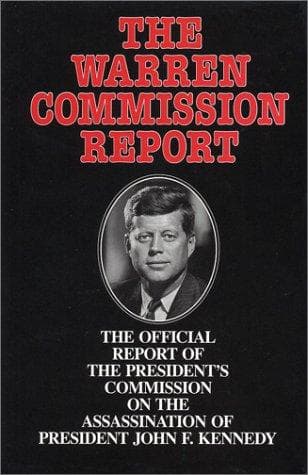
Report of the President's Commission on the Assassination of President John F. KennedyUnited States. Warren Commission
History
Report of the President's Commission on the Assassination of President John F. Kennedy
United States. Warren Commission
Kennedy, John F. (John Fitzgerald), 1917-1963 -- Assassination; Oswald, Lee Harvey
The FBI office in Dallas gave the local Secret Service representatives
the name of a possibly dangerous individual in the Dallas area who was
investigated. It also advised the Secret Service of the circulation on
November 21 of a handbill sharply critical of President Kennedy,[C2-24]
discussed in chapter VI of this report. Shortly before, the Dallas
police had reported to the Secret Service that the handbill had
appeared on the streets of Dallas. Neither the Dallas police nor the
FBI had yet learned the source of the handbill.[C2-25] No one else was
identified to the Secret Service through local inquiry as potentially
dangerous, nor did PRS develop any additional information between
November 12, when Lawson left Washington, and November 22. The adequacy
of the intelligence system maintained by the Secret Service at the time
of the assassination, including a detailed description of the available
data on Lee Harvey Oswald and the reasons why his name had not been
furnished to the Secret Service, is discussed in chapter VIII.
The Luncheon Site
An important purpose of the President’s visit to Dallas was to speak at
a luncheon given by business and civic leaders. The White House staff
informed the Secret Service that the President would arrive and depart
from Dallas’ Love Field; that a motorcade through the downtown area of
Dallas to the luncheon site should be arranged; and that following the
luncheon the President would return to the airport by the most direct
route. Accordingly, it was important to determine the luncheon site as
quickly as possible, so that security could be established at the site
and the motorcade route selected.
On November 4, Gerald A. Behn, agent in charge of the White House
detail, asked Sorrels to examine three potential sites for the
luncheon.[C2-26] One building, Market Hall, was unavailable for
November 22. The second, the Women’s Building at the State Fair
Grounds, was a one-story building with few entrances and easy to make
secure, but it lacked necessary food-handling facilities and had
certain unattractive features, including a low ceiling with exposed
conduits and beams. The third possibility, the Trade Mart, a handsome
new building with all the necessary facilities, presented security
problems. It had numerous entrances, several tiers of balconies
surrounding the central court where the luncheon would be held, and
several catwalks crossing the court at each level. On November 4,
Sorrels told Behn he believed security difficulties at the Trade Mart
could be overcome by special precautions.[C2-27] Lawson also evaluated
the security hazards at the Trade Mart on November 13.[C2-28] Kenneth
O’Donnell made the final decision to hold the luncheon at the Trade
Mart; Behn so notified Lawson on November 14.[C2-29]
Public-domain text, read in full here on John Shaqi.
Reviews
Reviews
No reviews yet
Be the first to share your thoughts on this work.
Elsewhere in the archive
Join the Discussion
Join the discussion
Sign in to leave a comment or review.
Sign InorCreate an account