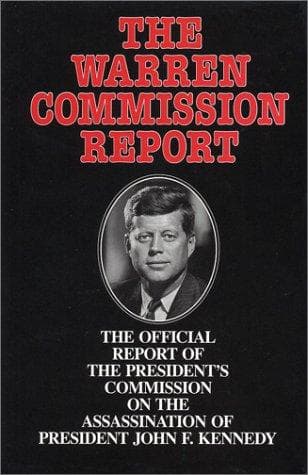
Report of the President's Commission on the Assassination of President John F. KennedyUnited States. Warren Commission
History
Report of the President's Commission on the Assassination of President John F. Kennedy
United States. Warren Commission
Kennedy, John F. (John Fitzgerald), 1917-1963 -- Assassination; Oswald, Lee Harvey
The President’s intention to pay a visit to Texas in the fall of 1963
aroused interest throughout the State. The two Dallas newspapers
provided their readers with a steady stream of information and
speculation about the trip, beginning on September 13, when the
Times-Herald announced in a front page article that President Kennedy
was planning a brief 1-day tour of four Texas cities--Dallas, Fort
Worth, San Antonio, and Houston.[C2-58] Both Dallas papers cited White
House sources on September 26 as confirming the President’s intention
to visit Texas on November 21 and 22, with Dallas scheduled as one of
the stops.[C2-59]
Articles, editorials, and letters to the editor in the Dallas Morning
News and the Dallas Times-Herald after September 13 reflected the
feeling in the community toward the forthcoming Presidential visit.
Although there were critical editorials and letters to the editors, the
news stories reflected the desire of Dallas officials to welcome the
President with dignity and courtesy. An editorial in the Times-Herald
of September 17 called on the people of Dallas to be “congenial
hosts” even though “Dallas didn’t vote for Mr. Kennedy in 1960, may
not endorse him in ’64.”[C2-60] On October 3 the Dallas Morning News
quoted U.S. Representative Joe Pool’s hope that President Kennedy would
receive a “good welcome” and would not face demonstrations like those
encountered by Vice President Johnson during the 1960 campaign.[C2-61]
Increased concern about the President’s visit was aroused by the
incident involving the U.S. Ambassador to the United Nations, Adlai
E. Stevenson. On the evening of October 24, 1963, after addressing
a meeting in Dallas, Stevenson was jeered, jostled, and spat upon
by hostile demonstrators outside the Dallas Memorial Auditorium
Theater.[C2-62] The local, national, and international reaction to
this incident evoked from Dallas officials and newspapers strong
condemnations of the demonstrators. Mayor Earle Cabell called on the
city to redeem itself during President Kennedy’s visit.[C2-63] He
asserted that Dallas had shed its reputation of the twenties as the
“Southwest hate capital of Dixie.”[C2-64] On October 26 the press
reported Chief of Police Curry’s plans to call in 100 extra off-duty
officers to help protect President Kennedy.[C2-65] Any thought that
the President might cancel his visit to Dallas was ended when Governor
Connally confirmed on November 8 that the President would come to Texas
on November 21-22, and that he would visit San Antonio, Houston, Fort
Worth, Dallas, and Austin.[C2-66]
Public-domain text, read in full here on John Shaqi.
Reviews
Reviews
No reviews yet
Be the first to share your thoughts on this work.
Elsewhere in the archive
Join the Discussion
Join the discussion
Sign in to leave a comment or review.
Sign InorCreate an account