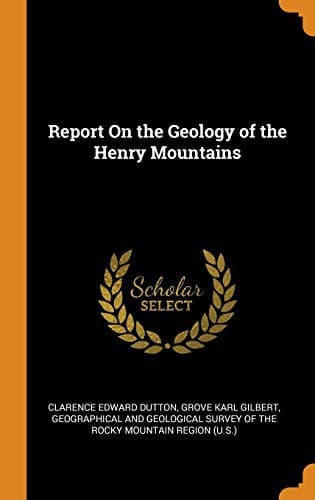
Report on the geology of the Henry MountainsGilbert, Grove Karl
Science
Report on the geology of the Henry Mountains
Gilbert, Grove Karl
Geology -- Utah -- Henry Mountains; Intrusions (Geology) -- Utah -- Henry Mountains
Upon such uncertain evidence no positive conclusion can be based, and it
is vain to build laccolites in the air. The most that can be said is
that the southern mountains need not be distinguished from the northern,
because at the present stage of degradation they contain laccolites of
the lower zone only.
_The Material of the Laccolites._
The intrusive rocks of the Henry Mountains were sampled with care.
Specimens were selected which had undergone little decomposition and
which represented all the prominent lithologic varieties. They were
chosen from the trachytes of both zones and of each of the mountain
masses; and they represent dikes and sheets, as well as laccolites. From
about thirty specimens thin slices were cut for microscopic examination.
Captain C. E. Dutton, of Omaha, Nebraska, was so kind as to undertake
the study of the collection, and the letter which embodies his
conclusions is given below. In accordance with his diagnosis I shall
call the intrusive rocks _porphyritic trachyte_; and I am glad to have
the weight of his authority in support of my belief that all the rocks
of the series are of one type, their resemblances far outweighing their
differences.
NOTE.—Persons desiring to examine the Henry Mountain trachytes under
the microscope can obtain mounted thin sections from Mr. Alexis A.
Julien, School of Mines, Columbia College, New York.
REPORT ON THE LITHOLOGIC CHARACTERS OF THE HENRY MOUNTAIN INTRUSIVES.
BY CAPTAIN C. E. DUTTON.
“I have examined with great interest and attention the Henry Mountain
rocks you sent me, and proceed to acquaint you with such results as my
limited facilities have permitted me to derive from the examination. It
is a very well defined series, having some marked characters which
distinguish it from the nearest allied group with which I am acquainted.
This is all the more interesting, because I am inclined to think that
these peculiarities may have a definable association with or relation to
the manner in which the intrusive rocks occur in those “laccolites”, as
you term them.
“The hand specimens show in most cases large and unusually perfect
crystals of orthoclase imbedded in a very compact uniform paste through
which hornblende is also disseminated rather more abundantly than is
usually the case where the dominant felspar is monoclinic. Micaceous
crystals appear to be wholly wanting and this is a notable circumstance,
since the trachytes of the Plateau country, to which these rocks are
most nearly allied, are seldom without one or more of them. The only
other mineral which is of frequent occurrence in the specimens is
magnetite (or possibly titanic iron), which is diffused in the usual
form of minute granules in many of them, but is scarce in several of
them. In general there is a great scarcity of mineral species and any
others than those mentioned are of the greatest rarity.
Public-domain text, read in full here on John Shaqi.
Reviews
Reviews
No reviews yet
Be the first to share your thoughts on this work.
Join the Discussion
Join the discussion
Sign in to leave a comment or review.
Sign InorCreate an account