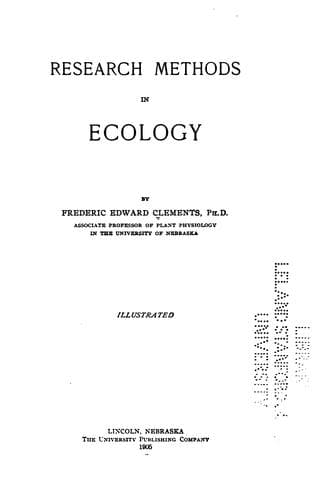
Research methods in ecologyClements, Frederic E. (Frederic Edward)
Science
Research methods in ecology
Clements, Frederic E. (Frederic Edward)
Plant ecology; Plant ecology -- Methodology
that young leaves do not wilt easily, especially in watery or succulent
plants. Three samples are again taken and the average water-content
determined as above. This is the non-available water or the echard. The
latter is then computed on the basis of 100 grams of dry soil, and this
result is subtracted from the holard to give the chresard in grams for
each 100 grams of dry weight. The chresard may also be expressed with
respect to 100 grams of moist soil. As a final precaution in basal work,
it is advisable to determine the chresard for six individuals of the
same species under as nearly the same conditions as possible. When it is
desired, however, to find the average chresard for a particular soil, it
is necessary to employ various species representing diverse phyads and
ecads. Such an investigation is necessarily very complicated, and must
be made the subject of special inquiry.
=53. Chresard readings in the field.= The especial difficulties which
must be overcome in the field are the exclusion of rain and dew and the
cutting off of the capillary water. It is evident, of course, that
experiments of this sort must also be entirely free from outside
disturbance. The choice of an area depends upon the scope of the study.
If the chresard is sought for a particular consocies, the block of soil
to be studied should show several species which are fairly
representative. In case the chresard of a certain species is to be
obtained, this species alone need be present, but it should be
represented by several individuals. Check plots are desirable in either
event, and at least two or three which are as nearly uniform as possible
should be chosen. The size and depth of the soil block depends upon the
plants concerned. It must be large enough that the roots of the
particular individuals under investigation are not disturbed. There is a
limit to the size of the mass that can be handled readily, and in
consequence the test plants must not be too large or too deeply rooted.
The task of cutting out the soil block requires a spade with a long
sharp blade. After ascertaining the spread and depth of the roots, the
block is cut so that a margin of several inches free from the roots
concerned is left on the sides and bottom. If the block is to be lifted
out of place, so that the sides are exposed to evaporation, this
allowance should be greater. In some cases, it may be found more
convenient to dig the plant up, place it in a large pot, and put the
latter back in the hole. As a general practice, however, this is much
less satisfactory.
Public-domain text, read in full here on John Shaqi.
Reviews
Reviews
No reviews yet
Be the first to share your thoughts on this work.
Join the Discussion
Join the discussion
Sign in to leave a comment or review.
Sign InorCreate an account