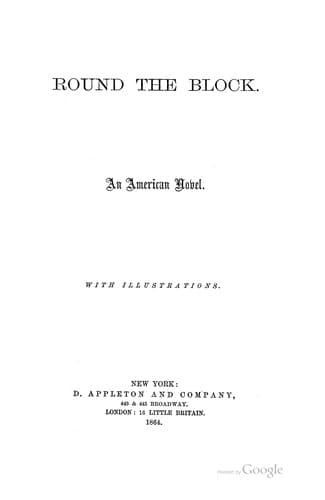
Round the Block: An American NovelBouton, John Bell
General
Round the Block: An American Novel
Bouton, John Bell
City and town life -- Fiction; Male friendship -- Fiction; New York (N.Y.) -- Social life and customs -- Fiction
Pet followed every lesson on the piano at Miss Pillbody's by three hours
of daily practice at home. Marcus had hired for her a small piano,
warranted to be just the thing for beginners. In other words, the keys
and pedals were nearly worn out, and could not be much further damaged
by unpractised hands and feet. This instrument was squeezed in between
the bureau and the washstand, filling up the last spare place in the
crowded little room. Pet wanted to have it set up in the next apartment,
and practise there in the cold, alone; but neither her father nor Marcus
would listen to that proposition for a moment.
Mr. Minford's nerves were extremely sensitive to sound. They vibrated to
it, like Aeolian harp in the wind. He placed pianos, cats, fish
peddlers, and hand organs on precisely the same footing, as nuisances.
Nothing but the ruling desire to make a lady of his child, could have
steeled him to the endurance, hour after hour, of her monotonous
"One--two--three--four," and the discordant banging which accompanied
those plaintive utterances.
The permanent discords with which the piano was afflicted, or the
striking of a false note, would sometimes set his teeth on edge; but he
would only hold his jaws tightly together, beat time with his head, and
smile a hypocritical approval. Sometimes he would torture himself
playfully, and make Pet laugh, by running a musical opposition with his
three-cornered file--a small but effective instrument.
Marcus Wilkeson was equally tolerant of Pet's practice, and there was
little false pretence in the patience with which he listened. Happily,
he was not all alive to sounds. Screeches and harmonies were pretty much
the same to him. Since he was a boy, he had been trying (privately) to
sing, or whistle, "Auld Lang Syne," and had not yet mastered the first
bar of it. He watched Pet's little fingers moving up and down the piano
with mechanical repetition, and was truly interested in the sight--for
two reasons: first, the motion was graceful; and second, she was
acquiring an accomplishment which he held in the highest esteem, because
Nature had put it entirely beyond his reach.
Public-domain text, read in full here on John Shaqi.
Reviews
Reviews
No reviews yet
Be the first to share your thoughts on this work.
Elsewhere in the archive
Join the Discussion
Join the discussion
Sign in to leave a comment or review.
Sign InorCreate an account