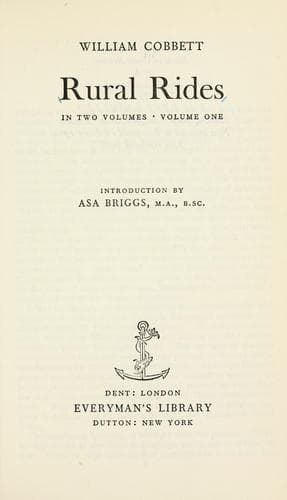
Great Britain -- Description and travel; Great Britain -- Rural conditions
will see them all, even the firs, lean from the sea breeze, except the
ash. You will see the oak _shaved up_ on the side of the breeze. But the
ash stands upright, as if in a warm woody dell. We have no tree that
attains a greater height than the ash; and certainly none that equals it
in beauty of leaf. It bears pruning better than any other tree. Its
timber is one of the most useful; and as underwood and fire-wood it far
exceeds all others of English growth. From the trees of an avenue like
that of Lord Hardwicke a hundred pounds worth of fuel might, if the
trees were ash, be cut every year in prunings necessary to preserve the
health and beauty of the trees. Yet, on this same land, has his lordship
planted many acres of larches and firs. These appear to have been
planted about twelve years. If instead of these he had planted ash, four
years from the seed bed and once removed; had cut them down within an
inch of the ground the second year after planting; and had planted them
at four feet apart, he would now have had about six thousand ash-poles,
on an average twelve feet long, on each acre of land in his plantation;
which, at three-halfpence each, would have been worth somewhere nearly
forty pounds an acre. He might now have cut the poles, leaving about 600
to stand upon an acre to come to trees; and while these were growing to
timber, the underwood would, for poles, hoops, broom-sticks, spars,
rods, and faggots, have been worth twenty-five or thirty pounds an acre
every ten years. Can beggarly stuff, like larches and firs, ever be
profitable to this extent? Ash is timber, fit for the wheelwright, at
the age of twenty years, or less. What can you do with a rotten fir
thing at that age?----This estate of Lord Hardwicke appears to be very
large. There is a part which is, apparently, in his own hands, as,
indeed, the whole must soon be, unless he give up all idea of rent, or,
unless he can _choack off_ the fundholder or get again afloat on the sea
of paper-money. In this part of his land there is a fine piece of
_Lucerne_ in rows at about eighteen inches distant from each other. They
are now manuring it with _burnt-earth_ mixed with some dung; and I see
several heaps of burnt-earth hereabouts. The directions for doing this
are contained in my _Year's Residence_, as taught me by Mr. William
Gauntlet, of Winchester.--The land is, all along here, laid up in those
wide and high ridges, which I saw in Gloucestershire, going from
Gloucester to Oxford, as I have already mentioned. These ridges are
ploughed _back_ or _down_; but they are ploughed up again for every
sowing.--At an Inn near Lord Hardwicke's I saw the finest parcel of
dove-house pigeons I ever saw in my life.--Between this place and
Huntingdon is the village of Caxton, which very much resembles almost a
village of the same size in _Picardy_, where I saw the women dragging
harrows to harrow in the corn. Certainly this village resembles nothing
Public-domain text, read in full here on John Shaqi.
Reviews
Reviews
No reviews yet
Be the first to share your thoughts on this work.
Join the Discussion
Join the discussion
Sign in to leave a comment or review.
Sign InorCreate an account