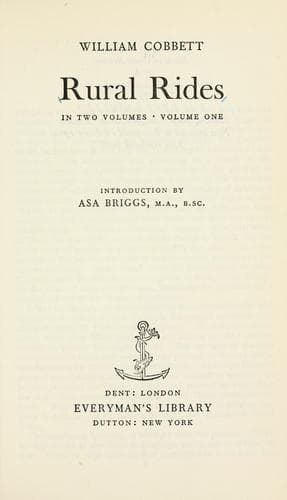
Great Britain -- Description and travel; Great Britain -- Rural conditions
"_female_" blossoms, tap-tap-tapping against a wall with a hammer that
weighs half an ounce. They have backs as straight and shoulders as
square as heroes of Waterloo; and who can blame them? The digging, the
mowing, the carrying of loads, all the break-back and sweat-extracting
work, they leave to be performed by those who have less _prudence_ than
they have. The great purpose of human art, the great end of human study,
is to obtain _ease_, to throw the burden of labour from our own
shoulders, and fix it on those of others. The crop of hay is very large,
and that part which is in, is in very good order. We shall have hardly
any hay that is not fine and sweet; and we shall have it, carried to
London, at less, I dare say, than 3_l._ a load, that is 18 cwt. So that
here the _evil_ of "_over-production_" will be great indeed! Whether we
shall have any projects for taking hay into _pawn_ is more than any of
us can say; for, after what we have seen, need we be surprised if we
were to hear it proposed to take butter and even milk into pawn. In
after times, the mad projects of these days will become proverbial. The
Oracle and the over-production men will totally supplant the
_March-hare_.--This is, all along here, and especially as far as
Stanmore, a very dull and ugly country: flat, and all grass-fields and
elms. Few _birds_ of any kind, and few _constant_ labourers being
wanted; scarcely any cottages and gardens, which form one of the great
beauties of a country. Stanmore is on a hill; but it looks over a
country of little variety, though rich. What a difference between the
view here and those which carry the eye over the coppices, the
corn-fields, the hop-gardens and the orchards of Kent! It is miserable
land from Stanmore to Watford, where we get into Hertfordshire. Hence to
Saint Albans there is generally chalk at bottom with a red tenacious
loam at top, with flints, grey on the outside and dark blue within.
Wherever this is the soil, the wheat grows well. The crops, and
especially that of the barley, are very fine and very forward. The
wheat, in general, does not appear to be a heavy crop; but the ears seem
as if they would be full from bottom to top; and we have had so much
heat, that the grain is pretty sure to be plump, let the weather, for
the rest of the summer, be what it may. The produce depends more on the
weather, previous to the coming out of the ear, than on the subsequent
weather. In the Northern parts of America, where they have, some years,
not heat enough to bring the Indian Corn to perfection, I have observed
that, if they have about fifteen days with the thermometer at _ninety_,
before the ear makes its appearance, the crop never fails, though the
weather may be ever so unfavourable afterwards. This allies with the old
remark of the country people in England, that "_May_ makes or mars the
wheat;" for it is in May that the ear and the grains are _formed_.
_Kensington, June 24, 1822._
Public-domain text, read in full here on John Shaqi.
Reviews
Reviews
No reviews yet
Be the first to share your thoughts on this work.
Elsewhere in the archive
Join the Discussion
Join the discussion
Sign in to leave a comment or review.
Sign InorCreate an account