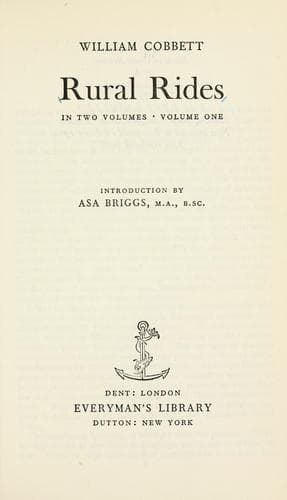
Great Britain -- Description and travel; Great Britain -- Rural conditions
Wycombe and Beaconsfield, where the soil is much about that last
described, the wheat continued to be equally early with that about
Wycombe. As I approached Uxbridge I got off the chalk upon a gravelly
bottom, and then from Uxbridge to Shepherd's Bush on a bottom of clay.
Grass-fields and elm-trees, with here and there a wheat or a bean-field,
form the features of this most ugly country, which would have been
perfectly unbearable after quitting the neighbourhoods of Hempstead,
Chesham and High Wycombe, had it not been for the diversion I derived
from meeting, in all the various modes of conveyance, the cockneys going
to _Ealing Fair_, which is one of those things which nature herself
would almost seem to have provided for drawing off the matter and
giving occasional relief to the overcharged _Wen_. I have traversed
to-day what I think may be called an average of England as to
corn-crops. Some of the best, certainly; and pretty nearly some of the
worst. My observation as to the wheat is, that it will be a fair and
average crop, and extremely early; because, though it is not a heavy
crop, though the ears are not long they will be full; and the earliness
seems to preclude the possibility of blight, and to ensure plump grain.
The barley and oats must, upon an average, be a light crop. The peas a
light crop; and as to beans, unless there have been rains where beans
are mostly grown, they cannot be half a crop; for they will not endure
heat. I tried masagan beans in Long Island, and could not get them to
bear more than a pod or two upon a stem. Beans love cold land and shade.
The earliness of the harvest (for early it must be) is always a clear
advantage. This fine summer, though it may not lead to a good crop of
turnips, has already put safe into store such a crop of hay as I believe
England never saw before. Looking out of the window, I see the harness
of the Wiltshire wagon-horses (at this moment going by) covered with the
chalk-dust of that county; so that the fine weather continues in the
West. The saint-foin hay has all been got in, in the chalk countries,
without a drop of wet; and when that is the case, the farmers stand in
no need of oats. The grass crops have been large everywhere, as well as
got in in good order. The fallows must be in excellent order. It must be
a sloven indeed that will sow his wheat in foul ground next autumn; and
the sun, where the fallows have been well stirred, will have done more
to enrich the land than all the dung-carts and all the other means
employed by the hand of man. Such a summer is a great blessing; and the
only draw-back is, the dismal apprehension of not seeing such another
for many years to come. It is favourable for poultry, for colts, for
calves, for lambs, for young animals of all descriptions, not excepting
the game. The partridges will be very early. They are now getting into
the roads with their young ones, to roll in the dust. The first broods
Public-domain text, read in full here on John Shaqi.
Reviews
Reviews
No reviews yet
Be the first to share your thoughts on this work.
Elsewhere in the archive
Join the Discussion
Join the discussion
Sign in to leave a comment or review.
Sign InorCreate an account