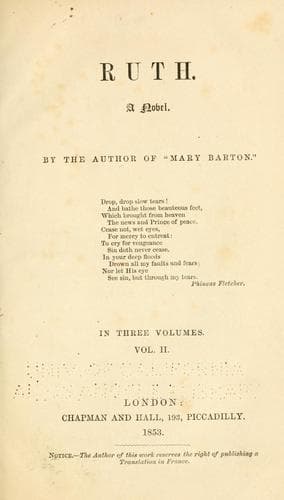
Domestic fiction; England -- Fiction; Mothers and sons -- Fiction; Religious fiction; Unmarried mothers -- Fiction
Now came the difficulty, and oh! for a seraph's tongue, and a
seraph's powers of representation! but there was no seraph at hand,
only the soft running waters singing a quiet tune, and predisposing
Miss Benson to listen with a soothed spirit to any tale, not
immediately involving her brother's welfare, which had been the cause
of her seeing that lovely vale.
"It is an awkward story to tell, Faith, but there is a young woman
lying ill at my lodgings whom I wanted you to nurse."
He thought he saw a shadow on his sister's face, and detected a
slight change in her voice as she spoke.
"Nothing very romantic, I hope, Thurstan. Remember, I cannot stand
much romance; I always distrust it."
"I don't know what you mean by romance. The story is real enough, and
not out of the common way, I'm afraid."
He paused; he did not get over the difficulty.
"Well, tell it me at once, Thurstan. I am afraid you have let some
one, or perhaps only your own imagination, impose upon you; but don't
try my patience too much; you know I've no great stock."
"Then I'll tell you. The young girl was brought to the inn here by a
gentleman, who has left her; she is very ill, and has no one to see
after her."
Miss Benson had some masculine tricks, and one was whistling a long,
low whistle when surprised or displeased. She had often found it a
useful vent for feelings, and she whistled now. Her brother would
rather she had spoken.
"Have you sent for her friends?" she asked at last.
"She has none."
Another pause and another whistle, but rather softer and more
wavering than the last.
"How is she ill?"
"Pretty nearly as quiet as if she were dead. She does not speak, or
move, or even sigh."
"It would be better for her to die at once, I think."
"Faith!"
That one word put them right. It was spoken in the tone which had
authority over her; it was so full of grieved surprise and mournful
upbraiding. She was accustomed to exercise a sway over him, owing to
her greater decision of character, and, probably, if everything were
traced to its cause, to her superior vigour of constitution; but at
times she was humbled before his pure, childlike nature, and felt
where she was inferior. She was too good and true to conceal this
feeling, or to resent its being forced upon her. After a time she
said,
"Thurstan, dear, let us go to her."
She helped him with tender care, and gave him her arm up the long and
tedious hill; but when they approached the village, without speaking
a word on the subject, they changed their position, and she leant
(apparently) on him. He stretched himself up into as vigorous a gait
as he could, when they drew near to the abodes of men.
On the way they had spoken but little. He had asked after various
members of his congregation, for he was a Dissenting minister in a
country town, and she had answered; but they neither of them spoke of
Ruth, though their minds were full of her.
Public-domain text, read in full here on John Shaqi.
Reviews
Reviews
No reviews yet
Be the first to share your thoughts on this work.
Elsewhere in the archive
Join the Discussion
Join the discussion
Sign in to leave a comment or review.
Sign InorCreate an account