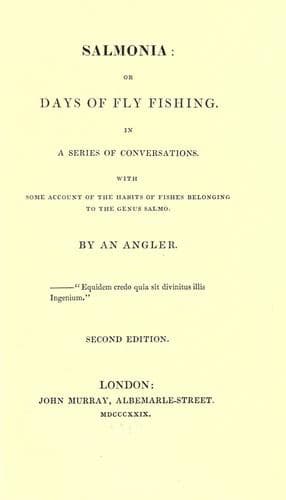
Salmonia; Or, Days of Fly Fishing: In a series of conversations. With some account of the habits of fishes belonging to the genus Salmo — John Shaqi
Salmonia; Or, Days of Fly Fishing: In a series of conversations. With some account of the habits of fishes belonging to the genus SalmoDavy, Humphry, Sir
Philosophy
Salmonia; Or, Days of Fly Fishing: In a series of conversations. With some account of the habits of fishes belonging to the genus Salmo
Davy, Humphry, Sir
Fishing
[_They proceed to the river_.]
HAL.—Now, my friends, I give up the two best pools to you till one
o’clock; and I shall amuse myself above and below—probably with trout
fishing. As there is a promise of a mixed day, with—what is rare in this
country—a good deal of sunshine, I will examine your flies a little, and
point out those I think likely to be useful; or rather, I will show you
my flies, and, as you all have duplicates of them, you can each select
the fly which I point out, and place in it a part of the book where it
may easily be found. First: when the cloud is on, I advise the use of
one of these three golden twisted flies, with silk bodies, orange, red
and pale blue, with red, orange, and gray hackle, golden pheasant’s
hackle for tail, and kingfisher’s blue and golden pheasant’s brown
hackle under the wing; beginning with the brightest fly, and changing to
the darker one. Should the clouds disappear, and it become bright,
change your flies for darker ones, of which I will point out three:—a
fly with a brown body and a red cock’s hackle, one with a dun body and
black hackle and light wing, and one with a black body, a hackle of the
same colour, and a brown mallard’s wing. All these flies have, you see,
silver twist round their bodies, and all kingfisher’s feather under the
wing, and golden pheasant’s feather for the tail. For the size of your
flies, I recommend the medium size, as the water is small to-day; but
trying all sizes, from the butterfly size of a hook of half an inch in
width, to one of a quarter. Now, Physicus, cast your orange fly into
that rapid at the top of the pool; I saw a large fish run there this
moment. You fish well, were common trout your object; but, in salmon
fishing, you must alter your manner of moving the fly. It must not float
quietly down the water; you must allow it to sink a little, and then
pull it back by a gentle jerk—not raising it out of the water,—and then
let it sink again, till it has been shown in motion, a little below the
surface, in every part of your cast. That is right,—he has risen.
PHYS.—I hold him. He is a noble fish!
HAL.—He is a large grilse, I see by his play; or a young salmon, of the
earliest born this spring. Hold him tight; he will fight hard.
PHYS.—There! he springs out of the water! Once, twice, thrice, four
times! He is a merry one!
HAL.—He runs against the stream, and will soon be tired,—but do not
hurry him. Pull hard now, to prevent him from running round that stone.
He comes in. I will gaff him for you. I have him! A goodly fish of this
tide. But see, Poietes has a larger fish at the bottom of the great
pool, and is carried down by him almost to the sea.
POIET.—I cannot hold him! He has run out all my line.
Public-domain text, read in full here on John Shaqi.
Reviews
Reviews
No reviews yet
Be the first to share your thoughts on this work.
Join the Discussion
Join the discussion
Sign in to leave a comment or review.
Sign InorCreate an account