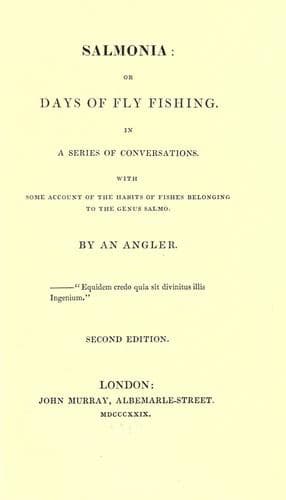
Salmonia; Or, Days of Fly Fishing: In a series of conversations. With some account of the habits of fishes belonging to the genus Salmo — John Shaqi
Salmonia; Or, Days of Fly Fishing: In a series of conversations. With some account of the habits of fishes belonging to the genus SalmoDavy, Humphry, Sir
Philosophy
Salmonia; Or, Days of Fly Fishing: In a series of conversations. With some account of the habits of fishes belonging to the genus Salmo
Davy, Humphry, Sir
Fishing
PHYS.—But there are surely other species of salmon, that live in the sea
and come into our rivers: I have heard of fish called _grays_, _bull
trout_, _scurfs_, _morts_, _peales_, and _whitlings_.
HAL.—I have never been able to identify more than the _salmo salar_, or
salmon, and _salmo trutta_, or sea trout, in the rivers of Britain and
Ireland. The whitlings I believe to be the young of the sea trout. A sea
trout which I saw in Ireland, called a bull trout, was of the same kind
as these you see here, but fresh water trout are sometimes carried in
floods to the sea, and come back larger and altered in colour and form,
and are then mistaken for new species: and as each river possesses a
peculiar variety belonging to it, this, with differences depending upon
food and size, will, I think, account for the peculiarities of
particular fish, without the necessity of supposing them distinct
species. I remember many years ago, the first time I ever fished for
salmon in spring in the Tweed, I caught with the fly, one fine morning
in March, two fish nearly of the same length: one was a male of the last
season, that had lost its melt; the other a female fresh from the sea.
They were so unlike, that they did not appear of the same species: the
spent or kipper salmon was long and lean, showing an immense head,
spotted all over with black and brown spots, and the belly almost black;
the other bright and silvery, without spots, and the head small. Even
the pectoral and anal fins had more spines in the newly run fish, some
of the smaller ones having been probably rubbed off in spawning by the
other. I would not for some time, till assured by an experienced
fisherman, believe, that the spent fish was a salmon; and when their
flesh was compared on the table, one was white, flabby, and bad, and
without curd; the other of the brightest pink, and full of dense curd.
Then, though of the same length, one weighed only 4lbs., the other
9½lbs. When it is recollected, that different salmon and sea trout spawn
at different times in the same river, and that fish of the same year,
being born at different seasons, from Christmas to Lady-day,—and having
migrated to the sea in spring—run up the rivers of all sizes in summer
and autumn—the young salmon from 2 to 10lbs. in weight, the young sea
trout from ½ to 3lbs. in weight—it is not difficult to account for the
variety of names given by casual observers to individuals of these two
species. But I must not forget my promise of sending a fish to the
Highlander, with whose sport we have interfered. There is a good salmon,
which shall be taken to him immediately, and for which I shall pay the
taxman his usual price of 5_d._ per pound.
FIFTH DAY.
HALIEUS—POIETES—ORNITHER—PHYSICUS.
MORNING.
HAL.—WELL, is your tackle all ready? It is a fine fresh and cloudy
morning, with a gentle breeze—a day made for salmon fishing.
Public-domain text, read in full here on John Shaqi.
Reviews
Reviews
No reviews yet
Be the first to share your thoughts on this work.
Join the Discussion
Join the discussion
Sign in to leave a comment or review.
Sign InorCreate an account