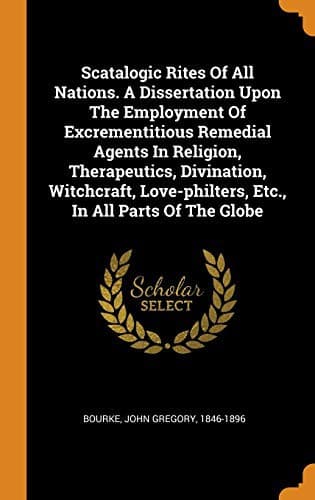
Scatalogic Rites of All Nations: A dissertation upon the employment of excrementitious remedial agents in religion, therapeutics, divination, witchcraft, love-philters, etc., in all parts of the globe — John Shaqi
Scatalogic Rites of All Nations: A dissertation upon the employment of excrementitious remedial agents in religion, therapeutics, divination, witchcraft, love-philters, etc., in all parts of the globeBourke, John Gregory
Religion
Scatalogic Rites of All Nations: A dissertation upon the employment of excrementitious remedial agents in religion, therapeutics, divination, witchcraft, love-philters, etc., in all parts of the globe
Bourke, John Gregory
Scatology
“A slight reaction for biliary matter seemed to show that there
was no obstruction of the bile ducts. These tests about used up
the four very small pills of the Lama’s ordure.
“Very respectfully and sincerely yours,
(Signed) “W. M. MEW.”
IX.
THE STERCORANISTES.
That Christian polemics have not been entirely free from such ideas may
be shown satisfactorily to any one having the leisure to examine the
various phases of the discussion upon the doctrine of the Eucharist.
The word “stercoranistes,” or “stercorarians,” is not to be found in
the last edition of the Encyclopædia Britannica; but in the edition
of 1841 the definition of the word is as follows: “Stercorarians, or
Stercoranistes, formed from _stercus_, ‘dung,’ a name which those of the
Romish church originally gave to such as held that the host was liable to
digestion and all its consequences, like other food.” This definition was
copied verbatim in Rees’s Cyclopædia of Arts, Sciences, and Literature,
Philadelphia.
The dispute upon “Stercoranisme” began in 831, upon the appearance of
a theological treatise by a monk named Paschasius Radbert.—(See the
“Institutes of Ecclesiastical History,” John Lawrence von Mosheim,
translated by John Murdock, D.D., New Haven, 1832, vol. ii. p. 104 _et
seq._)
The grossly sensual conception of the presence of the Lord’s body in
the sacrament, according to which that body is eaten, digested, and
evacuated like ordinary food, is of ancient standing, though not found
in Origen, nor perhaps in Rhabanus Maurus. It certainly originated with
a class of false teachers contemporary with or earlier than Rhabanus
Maurus, whom Paschasius Radbert condemns,—“Frivolum est ergo in hoc
mysterio cogitare in stercore ne commisceatur in digestione alterius
cibi” (De Corp. et Sanguin. Domin. cap. 20). He does not, however, apply
the term “Stercoranistes” to his opponents. Cardinal Humbert is the
first to so employ the word. This use was in a polemic against Nicetas
Pectoratus, written in support of Azymitism, etc. From this source the
word was adopted into common usage.—(Schrockli Kirchengesch. XXIII.? 429,
499; Herzog, Real Encyclop., s. v.; McClintock and Strong, Cyclop. of
Biblical, Theological, and Ecclesiastical Literature, New York, 1880; see
also Schaff-Herzog, “Cyclopædia of Religious Knowledge,” New York, 1881,
article “Stercoranistes.”)
Public-domain text, read in full here on John Shaqi.
Reviews
Reviews
No reviews yet
Be the first to share your thoughts on this work.
Join the Discussion
Join the discussion
Sign in to leave a comment or review.
Sign InorCreate an account