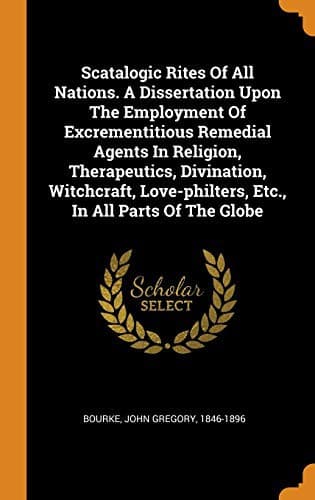
Scatalogic Rites of All Nations: A dissertation upon the employment of excrementitious remedial agents in religion, therapeutics, divination, witchcraft, love-philters, etc., in all parts of the globeBourke, John Gregory
Religion
Scatalogic Rites of All Nations: A dissertation upon the employment of excrementitious remedial agents in religion, therapeutics, divination, witchcraft, love-philters, etc., in all parts of the globe
Bourke, John Gregory
Scatology
“The Hindu wife is in Paradise compared to the Hindu widow. The condition
of the wife is bad enough. As the slave of her husband, she eats after
he is through, and she eats what is left. She has no education to speak
of, and her only hope of salvation is in him. She stands while he sits
in the household; and she cannot, if she lives in the interior, go to
the Ganges and bathe herself in the sacred water. I am told that in many
cases she considers it a privilege to bathe her husband’s feet after he
returns, and thinks that she gets some absolution from sin by drinking
the water.”—(Frank G. Carpenter, in “World,” New York, June 30, 1889.)
“Pyrrhus, king of Epirus, possessed the power of curing individuals
attacked by enlarged spleen by simply pressing his right foot upon that
viscera.”—(“The Physicians of the Middle Ages,” T. C. Minor, M.D.,
Cincinnati, Ohio, 1889, p. 5. A translation of “Le Moyen Age Médical,” of
Dr. Edmond Dupouy.)
X.
THE BACCHIC ORGIES OF THE GREEKS.
The Bacchic orgies of the Greeks, while not strictly assimilated to the
ur-orgies, can scarcely be overlooked in this connection.
Montfaucon describes the Omophagi of the Greeks: “Les Omophagies
étoient une fête des Grecs qui passoient la fureur Bacchique; ils
s’entortilloient, dit Arnobe, de serpens et mangeoient des entrailles
de Cabri crues, dont ils avaient la bouche toute ensanglantée; cela est
exprimée par le nom Omophage. Nous avons vu quelquefois des hommes tous
entortillez de serpens et particulièrement dans Mithras.”—(Montfaucon,
“L’Antiquité expliquée,” tome 2, book 4, p. 22.)
The references to serpent-worship are curious, in view of the fact that
such ophic rites still are celebrated among the Mokis, the next-door
neighbors of the Zuñis, and once existed among the Zuñis themselves. The
allusion to _Mithras_ would seem to imply that these orgies must have
been known to the Persians as well as the Greeks.
Bryant, speaking of the Greek orgies, uses this language: “Both in the
orgies of Bacchus and in the rites of Ceres, as well as of other deities,
one part of the mysteries consisted in a ceremony (_omophagia_), at which
time they ate the flesh quite crude with the blood. In Crete, at the
Dionisiaca, they used to tear the flesh with their teeth from the animal
when alive.”—(Bryant, “Mythology,” London, 1775, vol. ii. p. 12.)
And again, on p. 13: “The Mænules and Bacchæ used to devour the raw
limbs of animals which they had cut or torn asunder.... In the island of
Chios it was a religious custom to tear a man limb from limb, by way of
sacrifice to Dionysius. From all which we may learn one sad truth, that
there is scarce anything so impious and unnatural as not, at times, to
have prevailed.”—(Idem.)
Faber tells us that: “The Cretans had an annual festival ... in their
frenzy they tore a living bull with their teeth, and brandished serpents
in their hands.”—(Faber, “Pagan Idolatry,” London, 1816, vol ii. p. 265.)
BACCHIC ORGIES IN NORTH AMERICA.
Public-domain text, read in full here on John Shaqi.
Reviews
Reviews
No reviews yet
Be the first to share your thoughts on this work.
Elsewhere in the archive
Join the Discussion
Join the discussion
Sign in to leave a comment or review.
Sign InorCreate an account