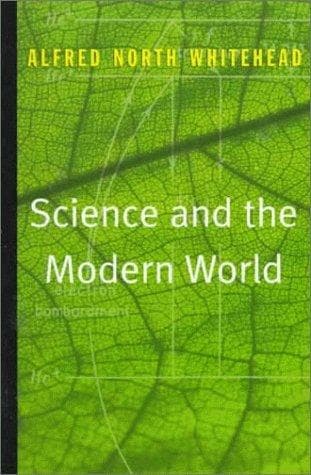
Science and the modern worldWhitehead, Alfred North
Religion
Science and the modern world
Whitehead, Alfred North
Science
There are, however, some subordinate explanations to be made which bring
in the minor characteristics which I have already mentioned. First, as
regards time, if material has existed during any period, it has equally
been in existence during any portion of that period. In other words,
dividing the time does not divide the material. Secondly, in respect to
space, dividing the volume does divide the material. Accordingly, if
material exists throughout a volume, there will be less of that material
distributed through any definite half of that volume. It is from this
property that there arises our notion of density at a point of space.
Anyone who talks about density is not assimilating time and space to the
extent that some extremists of the modern school of relativists very
rashly desire. For the division of time functions, in respect to
material, quite differently from the division of space.
Furthermore, this fact that the material is indifferent to the division
of time leads to the conclusion that the lapse of time is an accident,
rather than of the essence, of the material. The material is fully
itself in any sub-period however short. Thus the transition of time has
nothing to do with the character of the material. The material is
equally itself at an instant of time. Here an instant of time is
conceived as in itself without transition, since the temporal transition
is the succession of instants.
The answer, therefore, which the seventeenth century gave to the ancient
question of the Ionian thinkers, ‘What is the world made of?’ was that
the world is a succession of instantaneous configurations of matter,—or
of material, if you wish to include stuff more subtle than ordinary
matter, the ether for example.
We cannot wonder that science rested content with this assumption as to
the fundamental elements of nature. The great forces of nature, such as
gravitation, were entirely determined by the configurations of masses.
Thus the configurations determined their own changes, so that the circle
of scientific thought was completely closed. This is the famous
mechanistic theory of nature, which has reigned supreme ever since the
seventeenth century. It is the orthodox creed of physical science.
Furthermore, the creed justified itself by the pragmatic test. It
worked. Physicists took no more interest in philosophy. They emphasized
the anti-rationalism of the Historical Revolt. But the difficulties of
this theory of materialistic mechanism very soon became apparent. The
history of thought in the eighteenth and nineteenth centuries is
governed by the fact that the world had got hold of a general idea which
it could neither live with nor live without.
Public-domain text, read in full here on John Shaqi.
Reviews
Reviews
No reviews yet
Be the first to share your thoughts on this work.
Join the Discussion
Join the discussion
Sign in to leave a comment or review.
Sign InorCreate an account