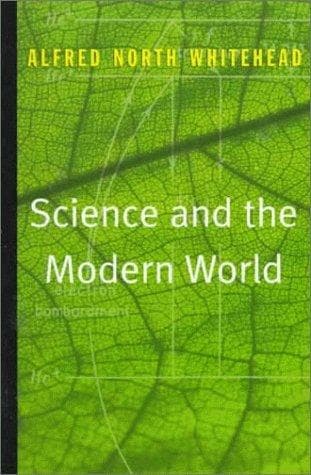
Science and the modern worldWhitehead, Alfred North
Religion
Science and the modern world
Whitehead, Alfred North
Science
Galileo considered this question, and at once pointed out that, apart
from eyes, ears, or noses, there would be no colours, sounds, or smells.
Descartes and Locke elaborated a theory of primary and secondary
qualities. For example, Descartes in his ‘Sixth Meditation’ says:[4]
“And indeed, as I perceive different sorts of colours, sounds, odours,
tastes, heat, hardness, etc., I safely conclude that there are in the
bodies from which the diverse perceptions of the senses proceed, certain
varieties corresponding to them, although, perhaps, not in reality like
them;....”
Footnote 4:
Translation by Professor John Veitch.
Also in his _Principles of Philosophy_, he says: “That by our senses we
know nothing of external objects beyond their figure [or situation],
magnitude, and motion.”
Locke, writing with a knowledge of Newtonian dynamics, places mass among
the primary qualities of bodies. In short, he elaborates a theory of
primary and secondary qualities in accordance with the state of physical
science at the close of the seventeenth century. The primary qualities
are the essential qualities of substances whose spatio-temporal
relationships constitute nature. The orderliness of these relationships
constitutes nature. The orderliness of these relationships constitutes
the order of nature. The occurrences of nature are in some way
apprehended by minds, which are associated with living bodies.
Primarily, the mental apprehension is aroused by the occurrences in
certain parts of the correlated body, the occurrences in the brain, for
instance. But the mind in apprehending also experiences sensations
which, properly speaking, are qualities of the mind alone. These
sensations are projected by the mind so as to clothe appropriate bodies
in external nature. Thus the bodies are perceived as with qualities
which in reality do not belong to them, qualities which in fact are
purely the offspring of the mind. Thus nature gets credit which should
in truth be reserved for ourselves: the rose for its scent: the
nightingale for his song: and the sun for his radiance. The poets are
entirely mistaken. They should address their lyrics to themselves, and
should turn them into odes of self-congratulation on the excellency of
the human mind. Nature is a dull affair, soundless, scentless,
colourless; merely the hurrying of material, endlessly, meaninglessly.
However you disguise it, this is the practical outcome of the
characteristic scientific philosophy which closed the seventeenth
century.
Public-domain text, read in full here on John Shaqi.
Reviews
Reviews
No reviews yet
Be the first to share your thoughts on this work.
Join the Discussion
Join the discussion
Sign in to leave a comment or review.
Sign InorCreate an account