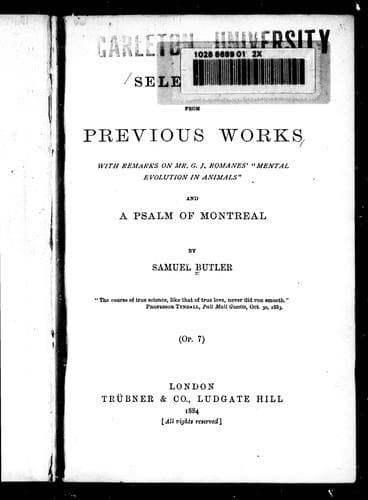
Selections from Previous Works: With Remarks on Romanes' Mental Evolution in Animals, and a Psalm of MontrealButler, Samuel
Philosophy
Selections from Previous Works: With Remarks on Romanes' Mental Evolution in Animals, and a Psalm of Montreal
Butler, Samuel
English literature -- 19th century -- Miscellanea; Romanes, George John, 1848-1894. Mental evolution in animals
Unfortunately, the apparatus necessary for this kind of science is so
costly as to be within the reach of few, involving, as it does, an
experience in the use of it for some preceding generations. Even those
who are born with the means within their reach must take no less pains,
and exercise no less self-control, before they can attain the perfect
unconscious use of them, than would go to the making of a James Watt or a
Stephenson; it is vain, therefore, to hope that this best kind of science
can ever be put within the reach of the many; nevertheless it may be
safely said that all the other and more generally recognised kinds of
science are valueless except in so far as they minister to this the
highest kind. They have no _raison d'etre_ unless they tend to do away
with the necessity for work, and to diffuse good health, and that good
sense which is above self-consciousness. They are to be encouraged
because they have rendered the most fortunate kind of modern European
possible, and because they tend to make possible a still more fortunate
kind than any now existing. But the man who devotes himself to science
cannot--with the rarest, if any, exceptions--belong to this most
fortunate class himself. He occupies a lower place, both scientifically
and morally, for it is not possible but that his drudgery should somewhat
soil him both in mind and health of body, or, if this be denied, surely
it must let him and hinder him in running the race for unconsciousness.
We do not feel that it increases the glory of a king or great nobleman
that he should excel in what is commonly called science. Certainly he
should not go further than Prince Rupert's drops. Nor should he excel in
music, art, literature, or theology--all which things are more or less
parts of science. He should be above them all, save in so far as he can
without effort reap renown from the labours of others. It is a _lache_
in him that he should write music or books, or paint pictures at all; but
if he must do so, his work should be at best contemptible. Much as we
must condemn Marcus Aurelius, we condemn James I. even more severely.
Public-domain text, read in full here on John Shaqi.
Reviews
Reviews
No reviews yet
Be the first to share your thoughts on this work.
Join the Discussion
Join the discussion
Sign in to leave a comment or review.
Sign InorCreate an account