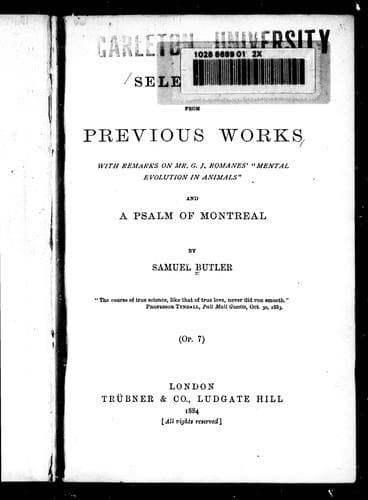
Selections from Previous Works: With Remarks on Romanes' Mental Evolution in Animals, and a Psalm of MontrealButler, Samuel
Philosophy
Selections from Previous Works: With Remarks on Romanes' Mental Evolution in Animals, and a Psalm of Montreal
Butler, Samuel
English literature -- 19th century -- Miscellanea; Romanes, George John, 1848-1894. Mental evolution in animals
"It is an experience we are continually encountering in other walks of
life," continues Dr. Carpenter, "that particular persons are guided--some
apparently by an original and others by _an acquired intuition_--to
conclusions for which they can give no adequate reason, but which
subsequent events prove to have been correct." And this, I take it,
implies what I have been above insisting on, namely, that on becoming
intense, knowledge seems also to become unaware of the grounds on which
it rests, or that it has or requires grounds at all, or indeed even
exists. The only issue between myself and Dr. Carpenter would appear to
be that Dr. Carpenter, himself an acknowledged leader in the scientific
world, restricts the term "scientific" to the people who know that they
know, but are beaten by those who are not so conscious of their own
knowledge; while I say that the term "scientific" should be applied (only
that they would not like it) to the nice sensible people who know what's
what rather than to the professorial classes.
And this is easily understood when we remember that the pioneer cannot
hope to acquire any of the new sciences in a single lifetime so perfectly
as to become unaware of his own knowledge. As a general rule, we observe
him to be still in a state of active consciousness concerning whatever
particular science he is extending, and as long as he is in this state he
cannot know utterly. It is, as I have already so often insisted, those
who do not know that they know so much who have the firmest grip of their
knowledge: the best class, for example, of our English youth, who live
much in the open air, and, as Lord Beaconsfield finely said, never read.
These are the people who know best those things which are best worth
knowing--that is to say, they are the most truly scientific.
Public-domain text, read in full here on John Shaqi.
Reviews
Reviews
No reviews yet
Be the first to share your thoughts on this work.
Join the Discussion
Join the discussion
Sign in to leave a comment or review.
Sign InorCreate an account