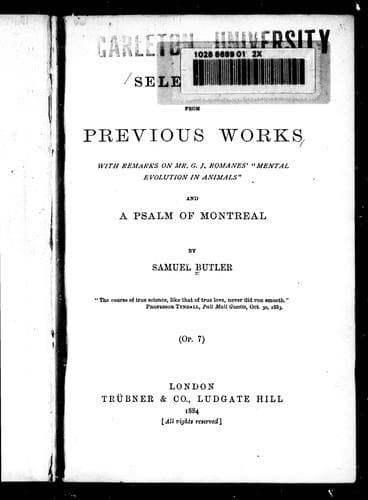
Selections from Previous Works: With Remarks on Romanes' Mental Evolution in Animals, and a Psalm of MontrealButler, Samuel
Philosophy
Selections from Previous Works: With Remarks on Romanes' Mental Evolution in Animals, and a Psalm of Montreal
Butler, Samuel
English literature -- 19th century -- Miscellanea; Romanes, George John, 1848-1894. Mental evolution in animals
Can we also show that there are no acquired actions which we can perform
in this automatic manner which were not at one time difficult, requiring
attention, and liable to repeated failure, our volition failing to
command obedience from the members which should carry its purposes into
execution?
If so, analogy will point in the direction of thinking that other acts
which we do even more unconsciously may only escape our power of self-
examination and control because they are even more familiar--because we
have done them oftener; and we may imagine that if there were a
microscope which could show us the minutest atoms of consciousness and
volition, we should find that even the apparently most automatic actions
were yet done in due course, upon a balance of considerations, and under
the deliberate exercise of the will.
We should also incline to think that even such an action as the
oxygenisation of its blood by an infant of ten minutes' old, can only be
done so well and so unconsciously, after repeated failures on the part of
the infant itself.
True, as has been already implied, we do not immediately see when the
baby could have made the necessary mistakes and acquired that infinite
practice without which it could never go through such complex processes
satisfactorily; we have therefore invented the word "heredity," and
consider it as accounting for the phenomena; but a little reflection will
show that though this word may be a very good way of stating the
difficulty, it does nothing whatever towards removing it. {96}
Why should heredity enable a creature to dispense with the experience
which we see to be necessary in all other cases before difficult
operations can be performed successfully?
What is this talk that is made about the experience _of the race_, as
though the experience of one man could profit another who knows nothing
about him? If a man eats his dinner, it nourishes _him_ and not his
neighbour; if he learns a difficult art, it is _he_ that can do it and
not his neighbour. Yet, practically, we see that the vicarious
experience, which seems so contrary to our common observation, does
nevertheless appear to hold good in the case of creatures and their
descendants. Is there, then, any way of bringing these apparently
conflicting phenomena under the operation of one law? Is there any way
of showing that this experience of the race, of which so much is said
without the least attempt to show in what way it may or does become the
experience of the individual, is in sober seriousness the experience of
one single being only, repeating in a great many different ways certain
performances with which it has become exceedingly familiar?
Public-domain text, read in full here on John Shaqi.
Reviews
Reviews
No reviews yet
Be the first to share your thoughts on this work.
Elsewhere in the archive
Join the Discussion
Join the discussion
Sign in to leave a comment or review.
Sign InorCreate an account