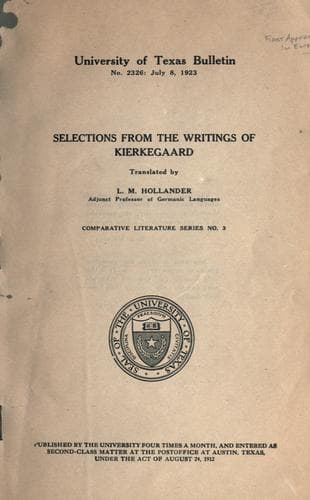
Selections from the Writings of KierkegaardKierkegaard, Søren
Religion
Selections from the Writings of Kierkegaard
Kierkegaard, Søren
Philosophy; Theology
Supposing I should yield to love and be made to laugh; or supposing
I should be cast down by terror, since I cannot find the narrow path
which lovers travel as easily as if it were the broad highway,
undisturbed by any doubts, which they surely have bestowed thought on
(seeing our times have, indeed, reflected about all[25] and consequently
will comprehend me when I assert that to act unreflectingly is nonsense,
as one ought to have gone through all possible reflections before
acting)--supposing, I say, I should yield to love! Would I not
insult past redress my beloved one if I laughed; or irrevocably plunge
her into despair if I were overwhelmed by terror? For I understand
well enough that a woman cannot be expected to have thought as
profoundly about these matters; and a woman who found love comical
(as but gods and men can, for which reason woman is a temptation
luring them to become ridiculous) would both betray a suspicious
amount of previous experience and understand me least. But a woman
who comprehended the terror of love would have lost her loveliness
and still fail to understand me--she would be annihilated; which
is in nowise my case, so long as my thought saves me.
Is there no one ready to laugh? When I began by wanting to speak
about the comical element in love you perhaps expected to be made to
laugh, for it is easy to make you laugh, and I myself am a friend of
laughter; and still you did not laugh, I believe. The effect of my
speech was a different one, and yet precisely this proves that I have
spoken about the comical. If there be no one who laughs at my
speech--well, then laugh a little at me, dear fellow-banqueters,
and I shall not wonder; for I do not understand what I have occasionally
heard you say about love. Very probably, though, you are among the
initiated as I am not.
Thereupon the Young Person seated himself. He had become more
beautiful, almost, than before the meal. Now he sat quietly, looking
down before him, unconcerned about the others. John the Seducer
desired at once to urge some objections against the Young Person's
speech but was interrupted by Constantin who warned against discussions
and ruled that on this occasion only speeches were in order. John said
if that was the case, he would stipulate that he should be allowed to be
the last speaker. This again gave rise to a discussion as to the order
in which they were to speak, which Constantin closed by offering to
speak forthwith, against their recognizing his authority to appoint the
speakers in their turn.
(Constantin's Speech)
Constantin spoke as follows:
Public-domain text, read in full here on John Shaqi.
Reviews
Reviews
No reviews yet
Be the first to share your thoughts on this work.
Join the Discussion
Join the discussion
Sign in to leave a comment or review.
Sign InorCreate an account