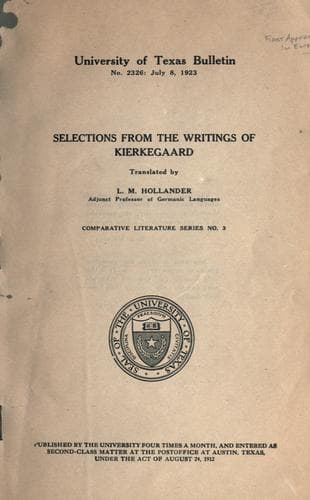
Selections from the Writings of KierkegaardKierkegaard, Søren
Religion
Selections from the Writings of Kierkegaard
Kierkegaard, Søren
Philosophy; Theology
Finally, if it were thinkable that a father influenced his son in
such fashion that his own nature was a condition from which the
son's nature could not free itself, then the contradiction would arise
in another direction; for in this case nothing more terrible is
thinkable than being a father. There is no comparison between killing
a person and giving him life--the former decides his fate only in
time, the other for all eternity. So there is a contradiction again, and
one both to laugh and to weep about. Is paternity then an
illusion--even if not in the same sense as is implied in Magdelone's
speech to Jeronymus[24]--or is it the most terrible thought imaginable?
Is it the greatest benefit conferred on one, or is it the sweetest
gratification of one's desire--is it something which just happens,
or is it the greatest task of life?
Look you, for this reason have I forsworn all love, for my thought
is to me the most essential consideration. So even if love be the most
exquisite joy, I renounce it, without wishing either to offend or to
envy any one; and even if love be the condition for conferring the
greatest benefit imaginable I deny myself the opportunity therefor--but
my thought I have not prostituted. By no means do I lack an eye for
what is beautiful, by no means does my heart remain unmoved when I
read the songs of the poets, by no means is my soul without sadness
when it yields to the beautiful conception of love; but I do not wish
to become unfaithful to my thought. And of what avail were it to be,
for there is no happiness possible for me except my thought have
free sway. If it had not, I would in desperation yearn for my
thought, which I may not desert to cleave to a wife, for it is my
immortal part and, hence, of more importance than a wife. Well do I
comprehend that if any thing is sacred it is love; that if faithlessness
in any relation is base, it is doubly so in love; that if any deceit
is detestable, it is tenfold more detestable in love. But my soul is
innocent of blame. I have never looked at any woman to desire her,
neither have I fluttered about aimlessly before blindly plunging, or
lapsing, into the most decisive of all relations. If I knew what the
lovable were I would know with certainty whether I had offended by
tempting any one; but since I do not know, I am certain only of
never having had the conscious desire to do so.
Public-domain text, read in full here on John Shaqi.
Reviews
Reviews
No reviews yet
Be the first to share your thoughts on this work.
Join the Discussion
Join the discussion
Sign in to leave a comment or review.
Sign InorCreate an account