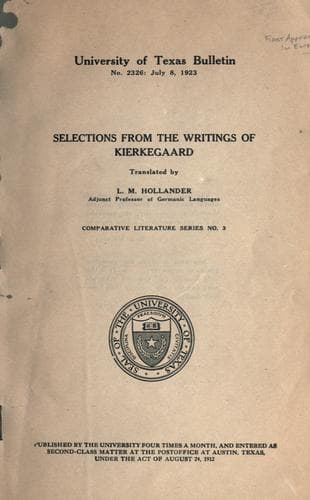
Selections from the Writings of KierkegaardKierkegaard, Søren
Religion
Selections from the Writings of Kierkegaard
Kierkegaard, Søren
Philosophy; Theology
A pity that Shakespeare has not presented us with a comedy of this
description in which the claim raised by a woman's infidelity is turned
down by irony; for not every one who is able to see the comical element
in this situation is able also to develop the thought and give it
dramatic embodiment. Let one but imagine Socrates surprising Xanthippe
in the act--for it would be un-Socratic even to think of Socrates
being particularly concerned about his wife's fidelity, or still worse,
spying on her--imagine it, and I believe that the fine smile which
transformed the ugliest man in Athens into the handsomest, would for the
first time have turned into a roar of laughter. It is incomprehensible
why Aristophanes, who so frequently made Socrates the butt of his
ridicule, neglected to have him run on the stage shouting: "Where is
she, where is she, so that I may kill her, i.e., my unfaithful
Xanthippe." For really it does not matter greatly whether or no
Socrates was made a cuckold, and all that Xanthippe may do in this
regard is wasted labor, like snapping one's fingers in one's pocket;
for Socrates remains the same intellectual hero, even with a horn on his
forehead. But if he had in fact become jealous and had wanted to kill
Xanthippe--alas! then would Xanthippe have exerted a power over
him such as the entire Greek nation and his sentence of death could
not--to make him ridiculous.
A cuckold is comical, then, with respect to his wife; but he may be
regarded as becoming tragical with respect to other men. In this fact we
may find an explanation of the Spanish conception of honor. But the
tragic element resides chiefly in his not being able to obtain redress,
and the anguish of his suffering consists really in its being devoid
of meaning--which is terrible enough. To shoot the woman, to
challenge her, to despise her, all this would only serve to render the
poor man still more ridiculous; for woman is the weaker sex. This
consideration enters in everywhere and confuses all. If she performs
a great deed she is admired more than man, because it is more than
was expected of her. If she is betrayed, all the pathos is on her
side; but if a man is deceived one has scant sympathy and little
patience while he is present--and laughs at him when his back is
turned.
Public-domain text, read in full here on John Shaqi.
Reviews
Reviews
No reviews yet
Be the first to share your thoughts on this work.
Join the Discussion
Join the discussion
Sign in to leave a comment or review.
Sign InorCreate an account