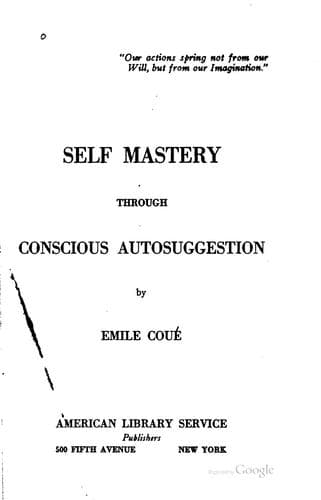
Self Mastery Through Conscious AutosuggestionCoué, Emile
Science
Self Mastery Through Conscious Autosuggestion
Coué, Emile
Mental suggestion
_M. E. Coué._--Here is the summary of the "Method" in a few
words: Contrary to what is taught, it is not our will which makes us
act, but our imagination (the unconscious). If we often do act as we
_will,_ it is because at the same time we think that we can. If it is
not so, we do exactly the reverse of what we wish. Ex: The more a
person with insomnia _determines_ to sleep, the more excited she
becomes; the more we _try_ to remember a name which we think
we have forgotten, the more it escapes us (it comes back only if, in
your mind, you replace the idea: "I have forgotten", by the idea "it
will come back"); the more we strive to prevent ourselves from
laughing, the more our laughter bursts out; the more we _determine_
to avoid an obstacle, when learning to bicycle, the more we rush
upon it.
We must then apply ourselves to directing our _imagination_ which
now directs us; in this way we easily arrive at becoming masters of
ourselves physically and morally.
How are we to arrive at this result? By the practice of conscious
_autosuggestion._
Conscious autosuggestion is based on this principle. Every idea that
we have in our mind becomes true for us and tends to realize itself.
Thus, if we _desire_ something, we can obtain it at the end of a
more or less long time, if we often repeat that this thing is going to
come, or to disappear, according to whether it is a good quality or a
fault, either physical or mental.
Everything is included by employing night and morning the general
formula: "Every day, _in every respect,_ I am getting better and
better".
_Question._--For those who are sad--who are in distress?
_Answer._--As long as you think: "I am sad", you _cannot_ be
cheerful, and in order to think something, it is enough to say without
effort: "I do think this thing--"; as to the distress it will disappear,
however violent it may be, _that_ I _can_ affirm.
A man arrives bent, dragging himself painfully along, leaning on
two sticks; he has on his face an expression of dull depression. As
the hall is filling up, M. E. Coué enters. After having questioned this
man, he says to him something like this: "So you have had
rheumatism for 32 years and you cannot walk. Don't be afraid, it's
not going to last as long as that again."
Then after the preliminary experiments: "Shut your eyes, and repeat
very quickly indeed, moving your lips, the words: 'It is going, it is
going' (at the same time M. Coué passes his hand over the legs of
the patient, for 20 to 25 seconds). Now you are no longer in pain, get
up and walk (the patient walks) quickly! quicker! more quickly still!
and since you can walk so well, you are going to run; run! Monsieur,
run!" The patient runs (joyously, almost as if he had recovered his
youth), to his great astonishment, and also to that of the numerous
persons present at the séance of April 27th, 1920. (Clinic of Dr.
Berillon.)
Public-domain text, read in full here on John Shaqi.
Reviews
Reviews
No reviews yet
Be the first to share your thoughts on this work.
Join the Discussion
Join the discussion
Sign in to leave a comment or review.
Sign InorCreate an account