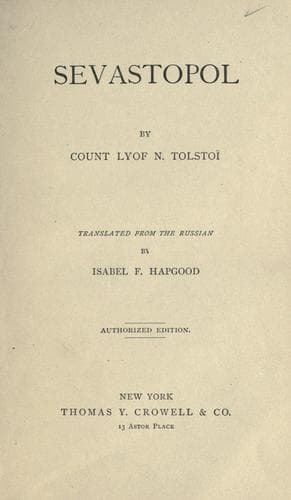
Sevastopol (Ukraine) -- History -- Siege, 1854-1855 -- Fiction
The thunder of the cannon continued with the same power as before, but
Yekaterinskaya street, along which Volodya walked, followed by the
taciturn Nikolaeff, was quiet and deserted. All that he could see,
through the thick darkness, was the wide street with the white walls of
large houses, battered in many places, and the stone sidewalk beneath
his feet; now and then, he met soldiers and officers. As he passed
along the left side of the street, near the Admiralty building, he
perceived, by the light of a bright fire burning behind the wall, the
acacias planted along the sidewalk, with green guards beneath, and the
wretchedly dusty leaves of these acacias.
He could plainly hear his own steps and those of Nikolaeff, who
followed him, breathing heavily. He thought of nothing; the pretty
little Sister of Mercy, Martzoff's leg with the toes twitching in its
stocking, the bombs, the darkness, and divers pictures of death floated
hazily through his mind. All his young and sensitive soul shrank
together, and was borne down by his consciousness of loneliness, and
the indifference of every one to his fate in the midst of danger.
“They will kill me, I shall be tortured, I shall suffer, and no one
will weep.” And all this, instead of the hero's life, filled with
energy and sympathy, of which he had cherished such glorious dreams.
The bombs burst and shrieked nearer and ever nearer. Nikolaeff sighed
more frequently, without breaking the silence. On crossing the bridge
leading to the Korabelnaya, he saw something fly screaming into the
bay, not far from him, which lighted up the lilac waves for an instant
with a crimson glow, then disappeared, and threw on high a cloud of
foam.
“See there, it was not put out!” said Nikolaeff, hoarsely.
“Yes,” answered Volodya, involuntarily, and quite unexpectedly to
himself, in a thin, piping voice.
They encountered litters with wounded men, then more regimental
transports with gabions; they met a regiment on Korabelnaya street;
men on horseback passed them. One of them was an officer, with his
Cossack. He was riding at a trot, but, on catching sight of Volodya, he
reined in his horse near him, looked into his face, turned and rode on,
giving the horse a blow of his whip.
“Alone, alone; it is nothing to any one whether I am in existence or
not,” thought the lad, and he felt seriously inclined to cry.
After ascending the hill, past a high white wall, he entered a street
of small ruined houses, incessantly illuminated by bombs. A drunken and
dishevelled woman, who was coming out of a small door in company with a
sailor, ran against him.
“If he were only a fine man,” she grumbled,—“Pardon, Your Honor the
officer.”
Public-domain text, read in full here on John Shaqi.
Reviews
Reviews
No reviews yet
Be the first to share your thoughts on this work.
Join the Discussion
Join the discussion
Sign in to leave a comment or review.
Sign InorCreate an account