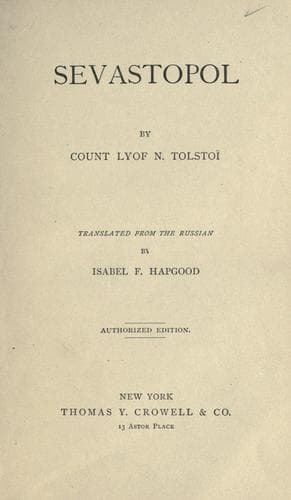
Sevastopol (Ukraine) -- History -- Siege, 1854-1855 -- Fiction
Poor Volodya was so overwhelmed by the thought that he was a coward,
that he espied scorn for himself in every glance, in every word, as
though they had been addressed to a pitiable poltroon. It seemed to him
that the commander of the battery had already divined his secret, and
was making sport of him. He answered, with embarrassment, that his
effects were on the Grafskaya, and that his brother had promised to
send them to him on the morrow.
But the lieutenant-colonel was not listening to him, and, turning to
the sergeant, he inquired:—
“Where are we to put the ensign?”
“The ensign, sir?” said the sergeant, throwing Volodya into still
greater confusion by the fleeting glance which he cast upon him, and
which seemed to say, “What sort of an ensign is this?”—“He can be
quartered downstairs, with the staff-captain, Your Excellency,” he
continued, after a little reflection. “The captain is at the bastion
just now, and his cot is empty.”
“Will that not suit you, temporarily?” said the commander.—“I think you
must be tired, but we will lodge you better to-morrow.”
Volodya rose and bowed.
“Will you not have some tea?” said the commander, when he had already
reached the door. “The samovár can be brought in.”
Volodya saluted and left the room. The lieutenant-colonel's servant
conducted him downstairs, and led him into a bare, dirty chamber, in
which various sorts of rubbish were lying about, and where there was
an iron bedstead without either sheets or coverlet. A man in a red
shirt was fast asleep on the bed, covered over with a thick cloak.
Volodya took him for a soldier.
“Piotr Nikolaïtch!” said the servant, touching the sleeper on the
shoulder. “The ensign is to sleep here.... This is our yunker,” he
added, turning to the ensign.
“Ah, don't trouble him, please,” said Volodya; but the yunker, a tall,
stout, young man, with a handsome but very stupid face, rose from the
bed, threw on his cloak, and, evidently not having had a good sleep,
left the room.
“No matter; I'll lie down in the yard,” he growled out.
XIII.
Left alone with his own thoughts, Volodya's first sensation was a fear
of the incoherent, forlorn state of his own soul. He wanted to go to
sleep, and forget all his surroundings, and himself most of all. He
extinguished the candle, lay down on the bed, and, taking off his coat,
he wrapped his head up in it, in order to relieve his terror of the
darkness, with which he had been afflicted since his childhood. But all
at once the thought occurred to him that a bomb might come and crush
in the roof and kill him. He began to listen attentively; directly
overhead, he heard the footsteps of the battery commander.
“Anyway, if it does come,” he thought, “it will kill any one who is
upstairs first, and then me; at all events, I shall not be the only
one.”
This thought calmed him somewhat.
“Well, and what if Sevastopol should be taken unexpectedly, in the
night, and the French make their way hither? What am I to defend myself
with?”
Public-domain text, read in full here on John Shaqi.
Reviews
Reviews
No reviews yet
Be the first to share your thoughts on this work.
Elsewhere in the archive
Join the Discussion
Join the discussion
Sign in to leave a comment or review.
Sign InorCreate an account