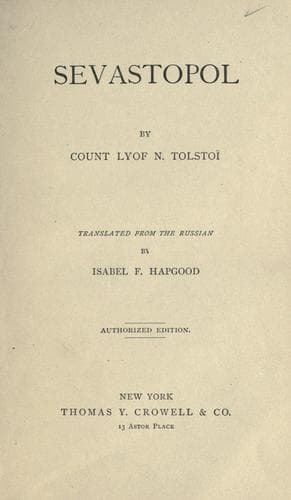
Sevastopol (Ukraine) -- History -- Siege, 1854-1855 -- Fiction
Sub-Lieutenant Dyadenko, a young officer, who talked with a Little
Russian accent, had a tattered cloak and dishevelled hair, although
he talked very loudly, and constantly seized opportunities to dispute
acrimoniously over some topic, and was very abrupt in his movements,
pleased Volodya, who, beneath this rough exterior, could not help
detecting in him a very fine and extremely good man. Dyadenko was
incessantly offering his services to Volodya, and pointing out to him
that not one of the guns in Sevastopol was properly placed, according
to rule.
Lieutenant Tchernovitzky, with his brows elevated on high, though he
was more courteous than any of the rest, and dressed in a coat that
was tolerably clean, but not new, and carefully patched, and though
he displayed a gold watch-chain on a satin waistcoat, did not please
Volodya. He kept inquiring what the Emperor and the minister of war
were doing, and related to him, with unnatural triumph, the deeds of
valor which had been performed in Sevastopol, complained of the small
number of true patriots, and displayed a great deal of learning, and
sense, and noble feeling in general; but, for some reason, all this
seemed unpleasant and unnatural to Volodya. The principal thing which
he noticed was that the other officers hardly spoke to Tchernovitzky.
Yunker Vlang, whom he had waked up on the preceding evening, was also
there. He said nothing, but, seated modestly in a corner, laughed when
anything amusing occurred, refreshed their memories when they forgot
anything, handed the vodka, and made cigarettes for all the officers.
Whether it was the modest, courteous manners of Volodya, who treated
him exactly as he did the officers, and did not torment him as though
he were a little boy, or his agreeable personal appearance which
captivated Vlang_a_, as the soldiers called him, declining his name,
for some reason or other, in the feminine gender, at all events, he
never took his big, kind eyes from the face of the new officer. He
divined and anticipated all his wishes, and remained uninterruptedly in
a sort of lover-like ecstasy, which, of course, the officers perceived,
and made fun of.
Before dinner, the staff-captain was relieved from the battery, and
joined their company. Staff-Captain Kraut was a light-complexioned,
handsome, dashing officer, with a heavy, reddish moustache, and
side-whiskers; he spoke Russian capitally, but too elegantly and
correctly for a Russian. In the service and in his life, he had been
the same as in his language; he served very well, was a capital
comrade, and the most faithful of men in money matters; but simply
as a man something was lacking in him, precisely because everything
about him was so excellent. Like all Russian-Germans, by a strange
contradiction with the ideal German, he was “praktisch” to the highest
degree.
Public-domain text, read in full here on John Shaqi.
Reviews
Reviews
No reviews yet
Be the first to share your thoughts on this work.
Elsewhere in the archive
Join the Discussion
Join the discussion
Sign in to leave a comment or review.
Sign InorCreate an account