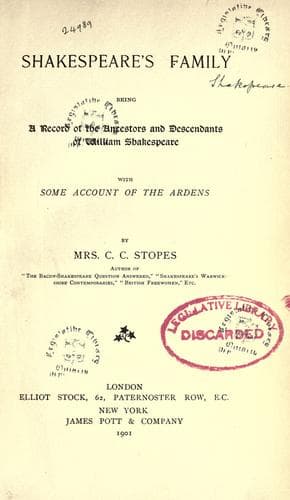
Shakespeare's familyStopes, C. C. (Charlotte Carmichael)
History
Shakespeare's family
Stopes, C. C. (Charlotte Carmichael)
Arden family; Shakespeare family; Shakespeare, William, 1564-1616 -- Family
Thomas Russell, Esq., and Francis Collins, gent., were to be overseers.
There were several witnesses. It was proved June 22, 1616, by John Hall,
at Westminster, but the inventory is unfortunately lost.
Much discussion has taken place over Shakespeare's legacy to his wife.
It may very simply and naturally have arisen from some conversation in
which a reference had been made to giving her "the best bed." But that
was the visitor's couch. "The second-best" would have been her own, that
which she had used through the years, and he wished her to feel that
that was not included in the "residue." That was to be her very own. As
to any provision for her, it must have taken the form of a settlement, a
jointure, or a dower. There is no trace of the first or second. But the
English law then assured a widow in a third of her husband's property
for life and the use of the capital messuage, if another was not
provided her. The absence of all special provision for Mrs. Shakespeare
seems to have arisen from her husband's knowledge of this and his trust
in the honour of Mr. John Hall, and the love of his daughters for their
mother. It also supports my opinion of her extreme delicacy of
constitution. She was not to be overweighted by mournful
responsibilities.
The indefiniteness of the residuary inheritance leaves room for surmise.
A curious reference, not, it seems to me, hitherto sufficiently noted,
occurs in the Burbage Case of 1635. Cuthbert, Winifred, the widow of
Richard, and William his son, recite facts concerning their father
James, who was the first builder of playhouses. "And to ourselves we
joined those deserving men, _Shakspere_, Hemings, Condell, Phillips, and
others, _partners[172] in the profittes of that they call the House_;
but _makeing the leases for twenty-one yeares hath been the destruction
of ourselves and others_, for _they dying at the expiration of three or
four yeares of their lease, the subsequent yeeres became dissolved to
strangers, as by marrying with their widdowes and the like by their
children_."
If Shakespeare's "lease" had not then expired, which seems to me
implied, it would have been "dissolved to a stranger" in the person of
Dr. Hall.
Some ready money would be required for the carrying out of the will.
Three hundred pounds left to Judith, and L73 13s. 4d. in smaller
bequests, would certainly run up to L400 by the payment of debts and
funeral expenses. The eagerness to leave all land to his own children is
another proof of Shakespeare's earnest desire to found a family.
Public-domain text, read in full here on John Shaqi.
Reviews
Reviews
No reviews yet
Be the first to share your thoughts on this work.
Join the Discussion
Join the discussion
Sign in to leave a comment or review.
Sign InorCreate an account