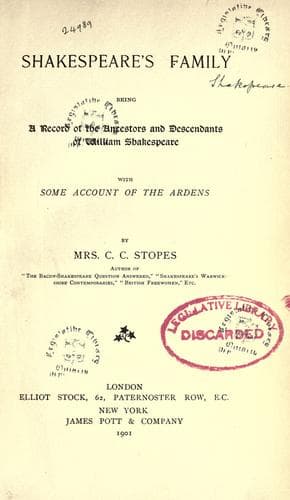
Shakespeare's familyStopes, C. C. (Charlotte Carmichael)
History
Shakespeare's family
Stopes, C. C. (Charlotte Carmichael)
Arden family; Shakespeare family; Shakespeare, William, 1564-1616 -- Family
"Shakespeare, at length thy pious fellowes give
The World thy Workes--thy Workes, by which outlive
Thy touche thy name must; when that stone is rent,
And Time dissolves thy Stratford monument,
Here we alive shall view thee still."
Crude and inartistic as it is, the bust must have had some likeness in
its earlier days to have satisfied critical eyes; but it has passed
through so many vicissitudes, and suffered so much restoration, that the
likeness may have entirely vanished by this time. Nevertheless, it
remains a witness to the affection of the surviving, and a witness,
Puritans though they were, that it was on account of the power of _his
pen_ that he deserved special remembrance.
Upon a mural tablet are other verses, which would seem not to have been
composed by his own friends, as they speak of Shakespeare's lying
"within this monument." Whoever wrote them, the family accepted them,
and the world has endorsed them:
[Illustration]
William Camden had finished his "Britannia" by 1617 (commenced in 1597),
printed in 1625. He says of Stratford Church: "In the chancel lies
William Shakespeare, a native of this place, who has given ample proof
of his genius and great abilities in the forty-eight plays he has left
behind him."
It is evident that the First Folio, 1623, was _intended_ by his
"fellows" at the Globe to stand as their monument to his memory, built
of the plays that had become their private property by purchase. The
verses that preface it, written by W. Basse, suggest that Shakespeare
should have been buried by Chaucer, Spenser, Beaumont, in the Poets'
Corner of Westminster Abbey. But the author withdraws his wish.
"Sleep, Brave Tragedian, Shakspere, sleep alone
Thy unmolested rest, unshared cave
Possess as Lord, not tenant to thy grave," etc.
Archy's "Banquet of Jests," printed in 1630, tells of one travelling
through Stratford, "a town most remarkable for the birth of famous
William Shakespeare." In the same year is said to have been written
Milton's memorable epitaph (printed 1632), a noble testimony from the
Puritan genius to the power of his play-acting brother:
"What needs my Shakspere for his honoured bones,
The labour of an age in piled stones?
Or that his hallowed reliques should be hid
Under a star y-pointing pyramid?
Dear son of memory, great heir of fame,
What needst thou such weak witness of thy fame?
Thou, in our wonder and astonishment,
Hast built thyself a live-long monument," etc.
By 1651 had already been suggested an annual commemoration of his life
in Samuel Sheppard's "Epigram on Shakspere," verse 6:
"Where thy honoured bones do lie,
As Statius once to Maro's urn,
Thither every year will I
Slowly tread and sadly turn."
Public-domain text, read in full here on John Shaqi.
Reviews
Reviews
No reviews yet
Be the first to share your thoughts on this work.
Join the Discussion
Join the discussion
Sign in to leave a comment or review.
Sign InorCreate an account