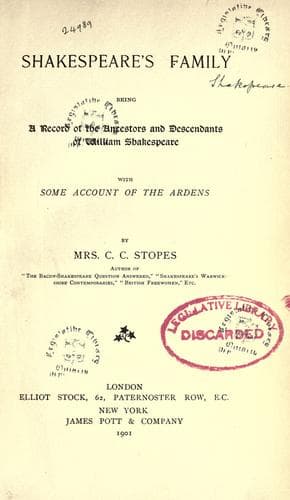
Shakespeare's familyStopes, C. C. (Charlotte Carmichael)
History
Shakespeare's family
Stopes, C. C. (Charlotte Carmichael)
Arden family; Shakespeare family; Shakespeare, William, 1564-1616 -- Family
In the rather remarkable testament of Thomas Nash,[182] first husband of
Shakespeare's only granddaughter, Elizabeth, he left L50 to Elizabeth
Hathaway, L50 to Thomas Hathaway, and L10 to Judith Hathaway. His wife
also remembered them, as will be afterwards shown. William Hathaway, of
Weston-upon-Avon, in the county of Gloucester, yeoman, and Thomas
Hathaway, of Stratford-upon-Avon, joiner, were parties to the New Place
settlement of 1647.
All this shows that the Shakespeares were not ashamed of their mother's
relatives. We do not know anything about Anne Shakespeare after her
husband's death until we reach the record of her own, "August 8th, 1623,
Mrs. Shakespeare."[183]
Tradition says that she earnestly desired to be buried in her husband's
grave. The survivors were not able to secure this, but they buried her
as near him as they could. Her daughter Susanna's grief is recorded in
touching lines, probably Latinized by Dr. Hall, placed on her tombstone:
[Illustration]
"Thou, my mother, gave me life, thy breast and milk; alas!
for such great bounty to me I shall give thee a tomb. How
much rather I would entreat the good angel to move the
stone, so that thy figure might come forth, as did the body
of Christ; but my prayers avail nothing. Come quickly, O
Christ; so that my mother, closed in the tomb, may rise
again and seek the stars."[184]
Of Anne Shakespeare's children we have already spoken. Susannah was born
May 26, 1583, Hamnet and Judith, February 2, 1584-85. Hamnet--surely the
model of Shakespeare's sweet boys--had died on August 11, 1596. So the
name Shakespeare had glorified was doomed to die with himself, and was
not to be borne by lesser men. His property the poet could and did
devise.
Much discussion has taken place concerning the poet's views of his
younger daughter and her marriage. I do not think these views at all
supported by his will. Three hundred pounds was a very large portion
indeed at the time. It was demised to her doubtless before her marriage,
but it was not altered in relation to her after her marriage. It would
be hard indeed to believe that such a ceremony, even without a license,
could be performed in the gossipy town of Stratford without the news of
it somehow reaching the father's ears, if there had been any attempt
really to deceive. There is no reason to imagine Shakespeare disapproved
of the alliance. The young man came of an old Stratford family. It is
possible, however, that the poet foresaw a certain degree of instability
of character in the youth, and therefore wished to make his will act as
a marriage settlement that would secure his daughter from starvation.
The second half of his bequest might only be touched by her husband, if
he had settled on her land of equal value. This Thomas Quiney does not
seem to have done.
Public-domain text, read in full here on John Shaqi.
Reviews
Reviews
No reviews yet
Be the first to share your thoughts on this work.
Elsewhere in the archive
Join the Discussion
Join the discussion
Sign in to leave a comment or review.
Sign InorCreate an account